
Need an OS for my pc!! !!




 28 Mar 2011, 12:56 pm

You act like Windows 7 is the only option available. The tasks you're talking about can be accomplished by any platform, and most of them are better at it than Windows. Linux is the 400-pound gorilla in the room on that front, and there are dozens of distributions to choose from. And the main point of using any Linux distribution is that they're all less resource intensive than Windows. I really don't think you should be talking about "logical fallacies", because you clearly don't know what they look like.
I never said no Windows = no computer, I said that if you're saying you don't need a better version of Windows for basic computing, then you can say anything.
That data is nowhere in your syllogism.
Today's distributions are stupid-simple to install. There are how-to articles and wikis everywhere. You can even order install discs from the big-time distributions like Fedora, Debian and Ubuntu. There are even vendors like Linux Certified who will sell you an entire PC with a distribution pre-installed. That's why I put "google" at the end of the chart.
Hell, if it takes the edge off, I'll walk the OP through the install...

 28 Mar 2011, 12:59 pm
Me use big words, me clever.
Of course they are, but I wasn't talking about installation, I was talking about day-to-day usage. It's fair to assume the OP would prefer to not find different programs for what s/he needs then learn a whole new system just to use this machine.
28 Mar 2011, 1:30 pm
Day-to-day usage would be no more complex than OS X or Windows.
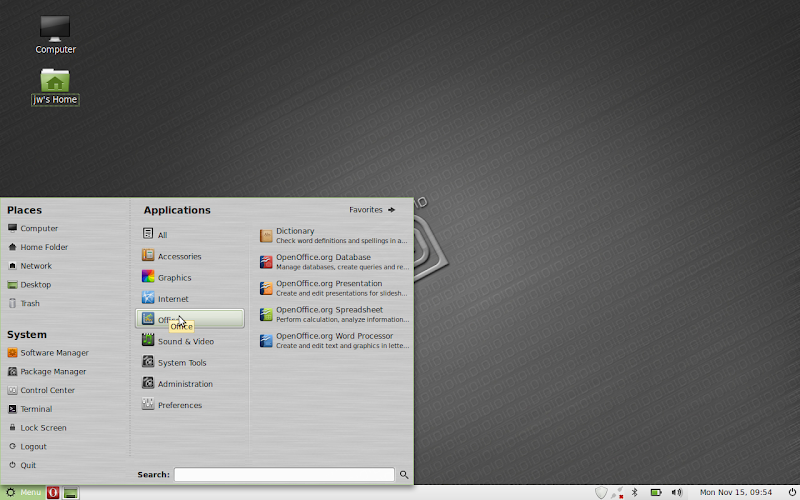
That's Linux Mint, the distro designed specifically to convert Windows users.
Last edited by Biokinetica on 29 Mar 2011, 3:36 am, edited 1 time in total.
 28 Mar 2011, 1:40 pm
Ubuntu/Mint are a lot easier to use than Windows, or even OS X. I mean, someone would really have to be an idiot to be unable to figure out how to use Mint.
_________________
WAR IS PEACE
FREEDOM IS SLAVERY
IGNORANCE IS STRENGTH
 28 Mar 2011, 8:30 pm
That's Linux Mint, the distro designed specifically to convert Windows users.
Nice looking desktop, but the issue with Linux is that the Linux developers do not have hundreds of millions of dollars in their budget for focus groups, UI pilot projects, etc. They spend most of their time coding; MS spends most of its time stomping out the kind of hiccups that result in hours of googling for Linux users. Linux has made leaps and bounds here but they're behind the curve. More behind the curve than MS is in performance at the moment.
29 Mar 2011, 3:26 am
Just noticed I made a lingual mistake.
That's Linux Mint, the distro designed specifically to convert Windows users.
Nice looking desktop, but the issue with Linux is that the Linux developers do not have hundreds of millions of dollars in their budget for focus groups, UI pilot projects, etc. They spend most of their time coding; MS spends most of its time stomping out the kind of hiccups that result in hours of googling for Linux users. Linux has made leaps and bounds here but they're behind the curve. More behind the curve than MS is in performance at the moment.
This sounds backwards. First, spending money on focus groups doesn't equate to quality. Just look at Activision; they do focus groups all the time, and still manage to turn out half-busted games that don't deliver anything unexpected. Second, while MS holds focus groups, they don't give those groups much variation in choice to begin with as they just build off the same GUI they've always had, tweaking one or two things each time. Third, most "problems" with Linux aren't even problems. Linux distros have very high standards, so what they perceive as a "problem" would be a non-issue for the vast majority of users - like the "bloat" of Ubuntu. As for being being "behind the curve", I don't see an app store built in to Windows...
Ubuntu/Mint are a lot easier to use than Windows, or even OS X. I mean, someone would really have to be an idiot to be unable to figure out how to use Mint.
I can confirm this from experience. I have Mint running on my aging laptop as the sole OS, and it's stupid-simple. That search bar at the bottom of the menu pulls results system-wide, and from the internet. Once you deck out the system with Gnome-do, Docky and your favorite browser, it becomes much faster and simpler than both OS X and Windows.
 29 Mar 2011, 4:12 am
I've actually taken part in a focus group. We were paid to assess street sign-age marking areas of high risk/fatalities for pedestrians.
The important thing to know about focus groups is that they do not innovate. Their role is to comment on designs and ideas. And their opinions have no binding powers.
For instance, In my case, it was already determined that yes, street signs would be erected. And that said street signs would be chosen from a set of designs already established. It was up to us to comment on what we liked, what colors were best and whatnot.
So in that sense we were vote tie-breakers for the designers.
In my case, they had chosen a good slice of the Canadian public for their focus group. We were able vote that a Christian cross would be inappropriate as a marker because it could be mistaken for marking nearby churches, and that it wasnt loaded with a meaning of danger, particularly for people of other faiths and children. In the end they started using a coffin shape which was one of the designs they presented to us.
It some ways its a process of deciding the "least worst option". If there had been a better design possible, it wasnt up to use to introduce it.
TL;DR focus groups pick the ice cream flavor they like best, they dont invent new ones.
_________________
davidred wrote...
I installed Ubuntu once and it completely destroyed my paying relationship with Microsoft.
29 Mar 2011, 8:48 am
That's Linux Mint, the distro designed specifically to convert Windows users.
It's not that it's perticuarly complicated, it's that you have to learn the ins and outs of not just the OS UI, but every single program. For example, someone used to using any version of Microsoft Office released in the past couple of years would have to make a lot of effort to learn OpenOffice (and, as much as I dislike Microsoft, I think MS Office is better than OpenOffice or Neo Office anyway, but that's just my opinion of course). And it's the same for everything - used to using Media Player? Get used to something else. And so on.
Don't get me wrong, I'm not dissing Linux, I'm just saying it seems stupid to tell someone to learn a whole new computing environment just so they can use some slightly outdated hardware when the system they're used to will run fine on it.
29 Mar 2011, 8:56 am
Don't get me wrong, I'm not dissing Linux, I'm just saying it seems stupid to tell someone to learn a whole new computing environment just so they can use some slightly outdated hardware when the system they're used to will run fine on it.
Your argument is perfectly valid.
_________________
davidred wrote...
I installed Ubuntu once and it completely destroyed my paying relationship with Microsoft.
29 Mar 2011, 11:34 am
That's Linux Mint, the distro designed specifically to convert Windows users.
It's not that it's perticuarly complicated, it's that you have to learn the ins and outs of not just the OS UI, but every single program. For example, someone used to using any version of Microsoft Office released in the past couple of years would have to make a lot of effort to learn OpenOffice (and, as much as I dislike Microsoft, I think MS Office is better than OpenOffice or Neo Office anyway, but that's just my opinion of course). And it's the same for everything - used to using Media Player? Get used to something else. And so on.
Don't get me wrong, I'm not dissing Linux, I'm just saying it seems stupid to tell someone to learn a whole new computing environment just so they can use some slightly outdated hardware when the system they're used to will run fine on it.
Open Office is actually simpler than Office 2007 & 2010. It's designed more like the older versions of Microsoft Office. The latest version is just a bunch of flashy icons. Unless the person is a screenwriter, they aren't using any functions that aren't in Open Office. There's a learning curve to everything; that's no excuse to not try something new. We also don't know anything about what the OP wants to do on their PC.
And Windows 7 will not "run fine" on it. If you try to put something like Windows 7 on that thing, that means no multitasking at all. Want to listen to music while you write a paper in MS Office 2010? No dice. This is reason enough to switch. On top of that, You have to pay for Windows and MS Office.
29 Mar 2011, 11:49 am
Your argument is perfectly valid.
Thank you

As I said, that's just an opinion of mine. OO in general just seems a bit less solid to me, too.
If the OP wants to try a brand new OS, then fine, no problem whatsoever. But if the OP just wants to get the computer working, Windows is the best option for the average user.
Fair point. See above.
If I've said it once, I've said it a thousand times: I have worse hardware than this running Windows 7 at a reasonable speed. I have in the past listened to music on iTunes (which is known to be bloated on PCs) while writing documents in Microsoft Word 2007 on that machine while it was running Windows 7 Ultimate. No problem at all.
29 Mar 2011, 12:43 pm
GNOME is pretty dead simple and self-explanatory. As a previous Mac user, I was able to start up my Ubuntu GNOME desktop and use it immediately, with no hassle whatsoever (and no, I was not particularly tech-savvy at the time). When I first installed Windows, I was left wondering where anything was. I still have trouble finding some things that should be pretty basic in Windows. The GUI is very obfuscated.
The MS Office UI keeps changing every couple years, and you are forced to pay for new versions because they make the file formats incompatible. LibreOffice does have some UI benefits over MS Office, at least for the spreadsheet components. And MS Excel should never be used for anything. It is such utter garbage.
But at that point, why not just stick with XP? Or Win98?
_________________
WAR IS PEACE
FREEDOM IS SLAVERY
IGNORANCE IS STRENGTH
29 Mar 2011, 1:08 pm
But Windows is what most normal users are used to, and your personal experience won't be the same as everyone else's. And of course you found GNOME easy to navigate after being a Mac user.
Thing is, moving operating systems, unless you're a geek who likes experimenting, is stressful. Hell, I am a geek who likes experimenting, but moving systems on my main computer would probably stress me out too (not that I don't play with them on secondary machines).
Incorrect. You can get compatibility packs for the older versions.
Office programs vs. other office programs is personal preference.
Because updating to a newer version of the same OS isn't the same as moving to a whole new system.
29 Mar 2011, 5:16 pm
GNOME is pretty dead simple and self-explanatory. As a previous Mac user, I was able to start up my Ubuntu GNOME desktop and use it immediately, with no hassle whatsoever (and no, I was not particularly tech-savvy at the time). When I first installed Windows, I was left wondering where anything was. I still have trouble finding some things that should be pretty basic in Windows. The GUI is very obfuscated.
Yeah, I remember you went back to OSX for a bit(grub issues?) and were shocked to discover features you never knew about. After a lifetime of Apple use, you hadnt discovered everything. I dont remember what it was though? Expose?
I left XP (actually I dual booted initially) because I had explored all the nooks and crannies that I could find. I was looking for a new adventure. Sure there were trillions of software packages out there, but the base system had become overly familiar, and I wanted something new.
_________________
davidred wrote...
I installed Ubuntu once and it completely destroyed my paying relationship with Microsoft.
29 Mar 2011, 5:37 pm
Its pretty close. Seven is a world of difference compared to XP. Mint for example is much closer in layout to XP than seven is.
_________________
davidred wrote...
I installed Ubuntu once and it completely destroyed my paying relationship with Microsoft.
29 Mar 2011, 6:38 pm
Granted, but then your comment that Windows is easier to use is baseless. If the claim is based only on what someone happens to have been used to, then all possible interfaces are equally user-friendly. Coming from an environment different from either, I found the adjustment to GNOME easier than the adjustment to Windows.
How so? The interface is not at all like OS X.
At the time I first installed Linux, I was not at all what you would consider tech-savvy. Aside from some wifi driver issues (which no longer exist in modern distros) it was extremely easy to make the switch. By last year, installing Linux Mint on a Mac was easier than installing OS X on a Mac.
Then why your blithe declaration that MS Office is better than OOo/LO? In the spreadsheet components, at least, an objective claim can be made: Excel sucks hard. It does not know how statistics works. LibreOffice Calc and Gnome-Office Gnumeric are much better.
XP to Vista/7 is a big change.
Spaces- the multiple-desktop capability that was included in Leopard, but disabled by default. Incidentally, Apple's implementation of multiple desktops sucks compared to GNOME's. It's supposed to have a neat little feature of assigning certain applications to certain desktops, which would be really handy if it wasn't so buggy and inconsistent.
_________________
WAR IS PEACE
FREEDOM IS SLAVERY
IGNORANCE IS STRENGTH


