Faith and human knowledge: do they differ?
Faith is what you have when you don't know about something. If you knew God existed, it wouldn't be faith, it would just be knowledge.
I disagree. The first religions were polytheist, and eventually it evolved to monotheism generally speaking. New ways of looking at the issue emerged new technologies of faith based models. There's also pantheism which is an even newer way of looking at religion in a more scientific view.
...if the conclusions we draw from experiments are, themselves, impossible to be incorrect. There's where it often breaks down. Error can and often does enter in during the conclusion phase of the scientific method. The human mind is still what we trust at that time, and is as capable of error in determining the true implications of an experiment's outcome as it is in erring in any other way. You can see the trees perfectly without seeing the forest; you can see the data of an experiment clearly, yet incorrectly ascribe meaning to it. The only part of any experiment free of error is the math itself: you get out of an experiment exactly what you put into it -- no more, no less. ANY undetected fault in the input (such as failing to account for an important, yet unknown variable) generates faulty output. And that faulty output is not always detected, or conspicuous enough to be. And, as I said, even non-faulty output has often proven ripe for misinterpretation.
The underlying problem is when you assume any part of the human mind to be error-free and also fully aware of everything relevant to the experiment. If experiments were the final determiners of truth, no conclusion would ever be found wrong. (Which is clearly historically not the case.) In other words, we would have found a way that the human mind is infallible. Such is a peculiar religion, not a reasonable assumption based on history.
_________________
Christianity is different than Judaism only in people's minds -- not in the Bible.
Oodain
Veteran
Joined: 30 Jan 2011
Age: 36
Gender: Male
Posts: 5,022
Location: in my own little tamarillo jungle,
Faith is what you have when you don't know about something. If you knew God existed, it wouldn't be faith, it would just be knowledge.
I disagree. The first religions were polytheist, and eventually it evolved to monotheism generally speaking. New ways of looking at the issue emerged new technologies of faith based models. There's also pantheism which is an even newer way of looking at religion in a more scientific view.
yes but the "newer" (to be honest we wouldnt know, we only have what we have) religions like pantheism and many of the more spiritual new age movements have very little to do with any divine figures but more a divine concept of reality,
_________________
//through chaos comes complexity//
the scent of the tamarillo is pungent and powerfull,
woe be to the nose who nears it.
...if the conclusions we draw from experiments are, themselves, impossible to be incorrect. There's where it often breaks down. Error can and often does enter in during the conclusion phase of the scientific method.
The way we get to general laws from a finite set of facts is by induction. Induction (unlike deduction) carries no guarantee that the conclusion (i.e. the general law) is true just because the premises (the set of baseline facts) is the case.
This was pointed out by David Hume in the 18 th century.
ruveyn
Faith is what you have when you don't know about something. If you knew God existed, it wouldn't be faith, it would just be knowledge.
I disagree. The first religions were polytheist, and eventually it evolved to monotheism generally speaking. New ways of looking at the issue emerged new technologies of faith based models. There's also pantheism which is an even newer way of looking at religion in a more scientific view.
yes but the "newer" (to be honest we wouldnt know, we only have what we have) religions like pantheism and many of the more spiritual new age movements have very little to do with any divine figures but more a divine concept of reality,
Which I think is okay as long as we keep at least one foot in the door so to speak.
At the risk of sounding arrogant, it is clear that most of the posters have no idea of what science or truth are.
To inform yourselves, I would suggest reading Hawkings "The Grand Design", and look up truth.
SCIENCE DOES NOT FIND TRUTH. At best it peruses. It produces theories which can be proven false, never proven true. In fact, the value of a theory is its usefulness.
truth does not exist in the physical world. It really only exists in math, logic, and as a useless term or a circular definition in the physical world.
If you do not know the difference between faith and knowledge, --- well I would suggest that you set aside a few hours doing searches. You will end up better information than posting that question to a collection of random people who share some neurological properties.
If you really do not know the difference between knowledge and faith, I would suggest that you have a trusted associate make all of your financial and medical decisions for you. Just make sure that your faith in that associate is well founded. Since it will not be based on knowledge, I am not sure on what it will be founded. Maybe revealed knowledge.
_________________
You can fool people, but nature can not be fooled
To inform yourselves, I would suggest reading Hawkings "The Grand Design", and look up truth.
SCIENCE DOES NOT FIND TRUTH. At best it peruses. It produces theories which can be proven false, never proven true. In fact, the value of a theory is its usefulness.
truth does not exist in the physical world. It really only exists in math, logic, and as a useless term or a circular definition in the physical world.
If you do not know the difference between faith and knowledge, --- well I would suggest that you set aside a few hours doing searches. You will end up better information than posting that question to a collection of random people who share some neurological properties.
If you really do not know the difference between knowledge and faith, I would suggest that you have a trusted associate make all of your financial and medical decisions for you. Just make sure that your faith in that associate is well founded. Since it will not be based on knowledge, I am not sure on what it will be founded. Maybe revealed knowledge.
Math itself is a theory. One could argue logic is also a theory. In fact everything understood about the physical universe is a theory, so what's your point exactly?
StonedMoonie
Snowy Owl
Joined: 27 Oct 2011
Age: 33
Gender: Female
Posts: 129
Location: Terra, Sol System
+over9000
_________________
Opportunities multiply as they are seized. -Sun Tzu
Nature creates few men brave, industry and training makes many -Machiavelli
You can safely assume that you've created God in your own image when it turns out that God hates all the same people you do
Is human knowledge absolutely true? History shows it is not. And if not, then it belongs to the "wishful thinking" category. (And "wishful thinking" includes that which is possibly true or false, not just false. Otherwise, nothing you wish would ever happen, which is obviously not the case. Not saying it happens BECAUSE you wish it.)
_________________
Christianity is different than Judaism only in people's minds -- not in the Bible.
Oodain
Veteran
Joined: 30 Jan 2011
Age: 36
Gender: Male
Posts: 5,022
Location: in my own little tamarillo jungle,
Is human knowledge absolutely true? History shows it is not. And if not, then it belongs to the "wishful thinking" category. (And "wishful thinking" includes that which is possibly true or false, not just false. Otherwise, nothing you wish would ever happen, which is obviously not the case. Not saying it happens BECAUSE you wish it.)
there is actual human knowledge or people would be just as inclined to jump out a window on the 100th floor as take the elevator down.
_________________
//through chaos comes complexity//
the scent of the tamarillo is pungent and powerfull,
woe be to the nose who nears it.
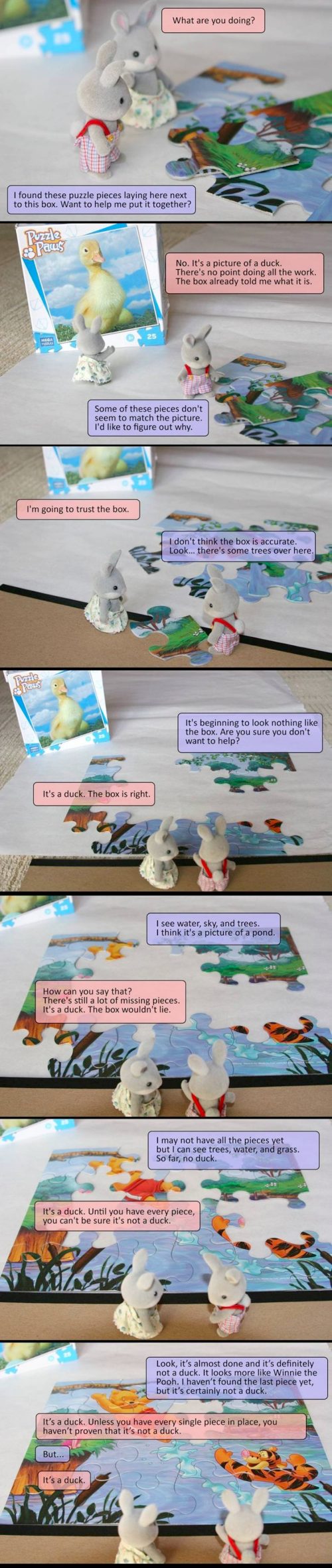
We do are not close to have all the pieces. But we do have enough puzzle pieces to be rather sure that if there is a deity it is not the one in the bible. For starters, we know the earth's true age, we have many explanations for phenomena that really differ to the bible's ways. Clearly an omniscient god would have written more accurate depictions of the phenomena he created.
More so, we have enough evidence to know that supernatural feats attributed in the bible to happen to characters are impossible. So,although we don't have all the answers, we have enough answers to know that reality has little to do with what's described by the bible, and the same happens with plenty of the most used religions across the world.
_________________
.