
Just How atheist are you?




 31 Jan 2008, 6:05 am

I mean, let's grant that I don't have any evidence at all in support of my claim but simply make the claim. But certainly, no else has any evidence to dispel my claim, either! So tell me, sir. May I take it that you'd be agnostic because, to paraphrase your words, "neither side has adequate evidence?"
How silly of you.
Jon
Ah, the dragon/teapot thing again. I just addressed this several posts back (though I believe it was an octopus in that incarnation).
_________________
Un-ban Chever! Viva La Revolucion!
 31 Jan 2008, 10:57 am
I mean, let's grant that I don't have any evidence at all in support of my claim but simply make the claim. But certainly, no else has any evidence to dispel my claim, either! So tell me, sir. May I take it that you'd be agnostic because, to paraphrase your words, "neither side has adequate evidence?"
How silly of you.
Jon
Propositions are only rationally sensible if the proposition makes a claim about a sense which may or may not be true. Propositions about the existence of an invisible dragon in your basement make no such claims: they are pure nonsense. Your desire to not believe in an invisible dragon is not rationality. It is aesthetics, or simple desire. If you say, "well, in the absence of evidence I do not tend to hold beliefs" this is certainly fine, but "in the absence of evidence you should not hold beliefs" you imposing an a priori axiom on your opponent. These criteria for belief are manufactured in each individuals mind, and supposing yours are the best is not only silly, its a nonsensical valuation.

Can atheists take a position on anything without arrogantly supposing themselves to be the pinnacle of human thought?

Of course. Strong atheists tend display a categorical ignorance of religious thought by straw-manning the entire debate as one about exactly a primitive, lowest common denominator version of the Christian God.
_________________
* here for the nachos.
Brittany2907
The ultimate storm is eternally on it's


Joined: 9 Jun 2007
Age: 34
Gender: Female
Posts: 4,718
Location: New Zealand
31 Jan 2008, 11:14 am
I would fall under the category of "positive athiesm". I think that if there is a god, it would have been proven. No proof = No god.
Humans have been around for many, many, many years...we have advanced technology and some have advanced minds...yet some STILL believe in something that can never be proven! Sorry...but I just can't understand why someone would do that.
_________________
I = Vegan!
Animals = Friends.

 31 Jan 2008, 3:00 pm
I personally think this isn't really important, by the way. There is quite a difference between discussing, for example, mathematical proof (which is a very real thing) and proof about nature and reality (which cannot be had.) The philosophical arguments about "propositions" do not really apply well regarding science fact, if all you are doing is bandying all this as a philosopher sitting in a rocking chair talking about the world around you without bothering to lift a finger to go see anything on your own. One cannot understand the world purely through rigorous philosophizing. As our history has ample evidence of.
So I really need to understand better what exactly you mean to say here.
Now, if people are making claims that god acts in the world around us, in a way that is measurable, that is a testable claim. And then it becomes the purvue of science. But history has well shown us that when people do that, they tend to find that when science can investigate such claims, they are not supportable by the overall weight of adduced evidence.
Bottom line is that there really is no rational room for agnosticism when the claims have no affirming evidence of any kind.
By the way, I don't mind folks having internal states of mind about the world around them and letting it inform them and help them get by in life. I just think there is no room whatsoever in governing by that. We all need to get along together and find accomodations through negotation towards goals we'd like to pursue and to do that we need to accept between us in the process only those things that can be evidenced well. If someone comes to the political table with some etherial idea about souls they believe in, there is no possible way we can discuss it or debate the pros and cons. It's simply going to be their way or the highway, as far as they are concerned. No sincere negotiation can take place. Which is the central reason why the high barrier between religion and state is required. There is no problem having internal states of mind, which are "true in mind" no matter what and therefore are not about reality, since because they are true no matter what nothing anyone might discover by way of evidence has any meaning to them and therefore their state of mind isn't about nature, but about something else entirely.
Yes, the invisible dragon idea can easily be expanded to include itself in your "sensibility" test, I imagine. And I'll happily expand it when you provide more information about exactly what your definition is and is not.
Jon
_________________
Say what you will about the sweet mystery of unquestioning faith. I consider a capacity for it terrifying. [Kurt Vonnegut, Jr.]
 01 Feb 2008, 5:01 am
Can atheists take a position on anything without arrogantly supposing themselves to be the pinnacle of human thought?
Heh.
It doesn't take the pinnacle of human thought to take even a cursory glance at reality and declare that atheism is the only tenable position.
But to take more than a cursory glance and declare that there is no difference between the two positions (atheism and theism)... that's worse than stupidity. That's a willful attempt at ignorance.

 01 Feb 2008, 8:05 am
Well I despise militant atheists and militant religious people equally as arrogant bigots who would rather jump to conclusions than accept their own ignorance. The universe is not black and white. This isn't a war. And you don't have to pick a side.
My opinion, and it is just an opinion (call me a snivelling fence sitter if you like): There really isn't enough evidence. While there is probably no bearded man sitting in heaven interfering with our daily lives, there is no evidence whether or not the universe was created by something or someone. The idea that the universe sprang into existance out of nothing (how can you get something from nothing?) is just as absurd as the idea that it was created by someone (what created the creator?). The fact that both ideas seem equally absurd is an indication that it is impossible for us to know. We are part of the universe and cannot truly understand anything outside of it.

 01 Feb 2008, 1:43 pm
Analogy with Russel's teapot would be reasonable and valid if God is material physical entity,like teapot or some animal.
Since absolutely no one have claimed that God is material physical entity,therefore this analogy is 'demolition of straw man'.
Existence of material physical entities is verified(or denied) by empirical a posteriori observation.
Most people claimed that God is immaterial,and therefore his existence can be only verified (or denied) by logical a priori demonstration.
But equating non-material entity with example of fictional material entity is simply ontologically wrong analogy.
If you want to negate highest being(God) a priori,you must demonstrate existence of another highest being(which is contradiction),or to demonstrate existence of highest non-being(which is again contradiction).
Seems to me that "strong" atheists obviously confuse knowledge and belief.
If we have evidence for something,then we have knowledge of something,not belief.
Reason of believing something is because that something has not been proved.
http://en.wikipedia.org/wiki/Belief
Entire purpose of belief is about something that has not been proved,or disproved.
So when I don't have proof for something,I have right to believe(or disbelieve) in something.
But to claim that disbelief is more rational then belief,because lack of proves is fallacy of equating knowledge and belief.
If your belief (or disbelief) is based on solid evidence,then your belief(or disbelief) is true and justified,and you have knowledge.
Disbelief in God is same as belief in God,and is not more rational.
Atheist response could be:"Disbelief in Russel's teapot is same as belief in Russel's teapot,and is not more rational."
To which I must point to my objections at the beginning of this post.
Agnostics claim that they don't know,while Atheists claim that they do not believe.This is big difference.
Atheism is disbelief,and therefore is irrational as belief.
Octopus is earthly sea animal.This comes from definition of octopus.
Therefore octopus cannot live in the center of universe.
Since octopus is an earthly animal,he is particular existence that is dependent on existence of universe.
Universe is by definition everything that exists.
Universe can exist without any octopus,while octopus cannot exist without universe.
Universe is therefore necessary for octopus,while octopus is contingent for universe.
Therefore giant octopus (no matter how big he is) cannot create everything.
For creation of everything is necessary existence of unlimited intellect,that is not bound to particular nature (like octopus).
Your statement can be disproved very easy.
What do you want Theists to do?Comb the very edges of the universe to ensure that said something really exist?That's foolish.
Nope,burden of proof lies on negative claim as well.
If you say that something does not exist,you must prove that claim as well.
http://en.wikipedia.org/wiki/Pseudoskepticism
Same could be said about PSYCHOLOGICAL NEED for irrational disbelief in God.
Since logic itself is not object of natural sciences,therefore logic itself cannot be 'scientifically true'.
If you believe in claim that god cannot be proven,therefore you must prove that God cannot be proven,according to your own standard.
P.S
My personal observations:
1.Theist=a person that wants to believe in existence of God(or care about him in positive sense).
2.Deist=a person that believes in existence of God(in general).
3.Agnostic=a person that does not know if God exists (or does not care).
4.Non-Theist=a person that does not believe in existence of God (in general).
5.Atheist=a person that does not want to believe in existence of God (or care about him in negative sense).
_________________
"All work and no play makes Jack a dull boy"
Jack Torrance
 01 Feb 2008, 2:27 pm
Witt, you are incorrect. The teapot analogy has nothing to do with its physicality. It just means that any absurd claim can be considered equivalent to the notion of God, since they all lack evidence. Non-material things can also leave evidence.
There is evidence that life was not "intelligently designed", but rather evolved. This has to do with it's nature, it's flaws, and it's lack of irreduceable complexity. Atheism is rational, since there is evidence for it. Not proof, but enough evidence to show that it is the most likely explanation for our observations.
 01 Feb 2008, 2:31 pm
Octopus is earthly sea animal.This comes from definition of octopus.
Therefore octopus cannot live in the center of universe.
Since octopus is an earthly animal,he is particular existence that is dependent on existence of universe.
Universe is by definition everything that exists.
Universe can exist without any octopus,while octopus exist without universe.
Universe is therefore necessary for octopus,while octopus is contingent for universe.
Therefore giant octopus (no matter how big he is) cannot create everything.
For creation of everything is necessary existence of unlimited intellect,that is not bound to particular nature (like octopus).
Your statement can be disproved very easy.
You didn't exactly disprove it. How do you know there aren't other species of Octopus that have adapted and fly around on nothing and create universes? How do you know it isn't too complex for even the smartest human to understand? How do you know the Octopus wasn't sent to our planet from another Universe and blended in with our planet, and now resides in the Ocean? How do you know the octopus wasn't created before the Universe was and has put you in a false reality, hiding itself from it's true talents. Yes, this is completely stupid and appears to make no sense at all but the "God" belief is no different.
First of all, the Bible is the thing that gave us the term God, as a being described as an all powerful male who created everything. Why would God be male? Shouldn't he be genderless? Why does God need a reproductive organ? Sounds creepy to me. The entire book is stupid. The fact that it's being used even today is stupid. It's so embedded into society that it's become fact even though there is no proof or even any sense in any of it. And what annoys me more are the people who say God is the Universe and he is not living. That's completely ridiculous, if you're going to make a belief like that why even use the word "God", just get rid of that word completely if the belief you are making does not have to do with primitive belief systems like Judism, Christianity or Islam. These religions are useless and heavily outdated, in fact all religions are useless in general. I try not to get into arguments with religious people because it ends up in a circle where the truth is they have no evidence of anything, it's all myth modified over time and inserted in a book.
My point is, there is absolutely no reason to believe in a religion, none have any proof at all. No proof means it didn't happen. *sigh*
01 Feb 2008, 2:38 pm
If you say that something is a teapot,unicorn or monster made out of spaghetti you are making a posteriori statement about something particular that have certain material traits.
Material trait of teapot is that it is used for tea,for unicorn that is horse with horn,for spaghetti monster is that is made out of spaghetti.
Evidence for material objects is not same thing as evidence for non-material objects.
While you can negate claim of existence of certain material objects (like space aliens) with those analogies,you can never use this a posteriori claims for refuting a priori claim.
_________________
"All work and no play makes Jack a dull boy"
Jack Torrance
01 Feb 2008, 3:01 pm
Then by your definition this is not an Octopus (a sea animal) but something else.
Particular existence like Octopus is limited by the fact that he is octopus,and therefore cannot create universe.
If octopus created universe (everything that exists),then he could not be sent from another universe.
How can particular existence,like octopus,exist before everything that exists(universe)?
I know what you are trying to show,however this would all be correct if God is material living being.
But no one (even most radical Evangelists or Islamists) claim that.
Wow,hold there a second....
Where do you get claim that Bible gives is term 'God'?
Have you read Bhagavad Gita? ,Avesta?,Vedas?,Theogony?
During French revolution,there was 'cult of reason':
http://en.wikipedia.org/wiki/Cult_of_Reason
In which reason has been presented as woman.
Why reason has to be female?
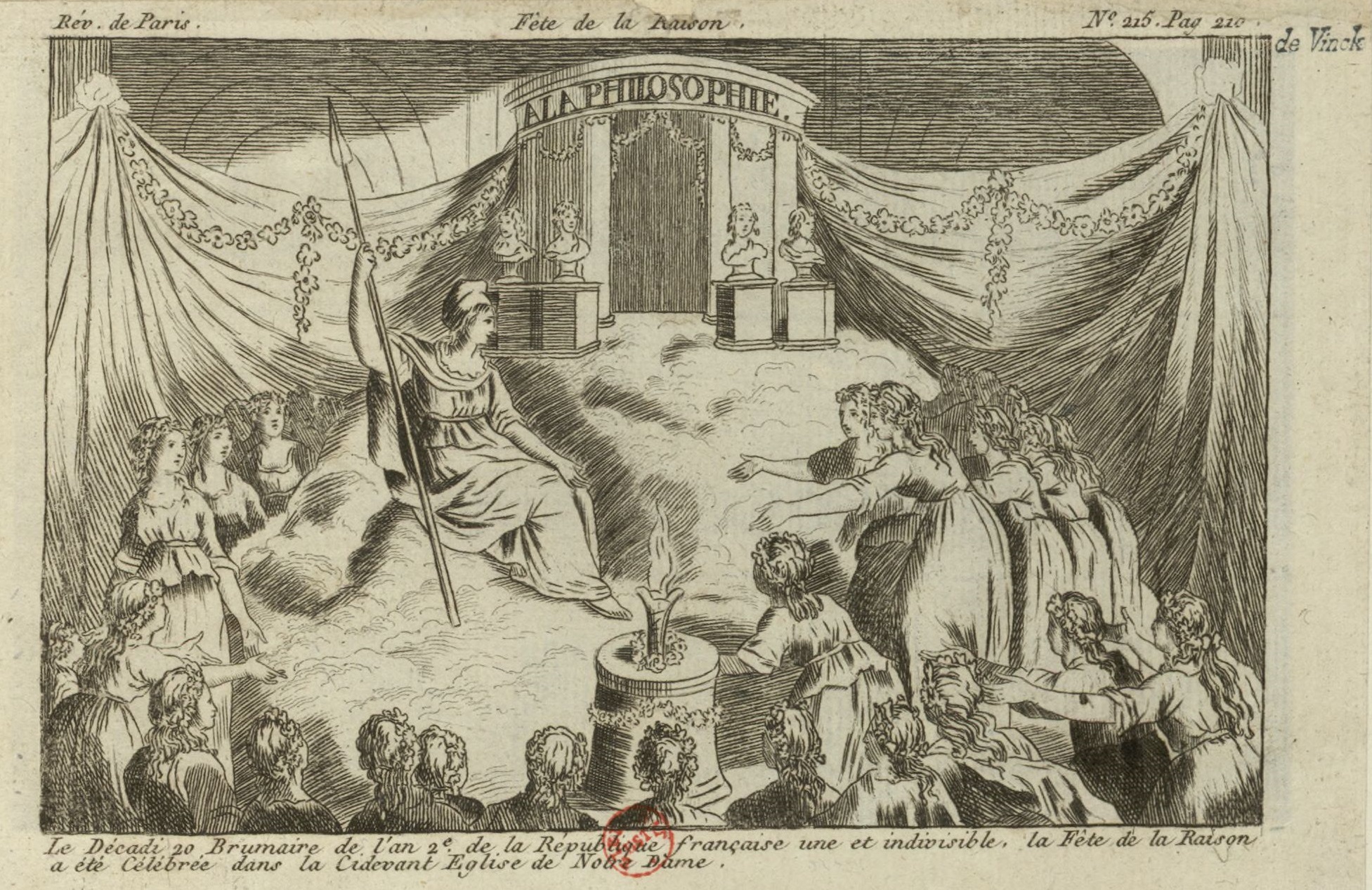
Does this mean that reason is stupid?
I'm not sure what Bible has to do with God?
God can exist,and Bible can be wrong.
When you have proof,then you have reason to know,not to believe.
What do you consider as proof?
_________________
"All work and no play makes Jack a dull boy"
Jack Torrance
 01 Feb 2008, 11:48 pm
Analogy with Russel's teapot would be reasonable and valid if God is material physical entity,like teapot or some animal.
Since absolutely no one have claimed that God is material physical entity,therefore this analogy is 'demolition of straw man'.
Existence of material physical entities is verified(or denied) by empirical a posteriori observation.
Most people claimed that God is immaterial,and therefore his existence can be only verified (or denied) by logical a priori demonstration.
But equating non-material entity with example of fictional material entity is simply ontologically wrong analogy.
If you want to negate highest being(God) a priori,you must demonstrate existence of another highest being(which is contradiction),or to demonstrate existence of highest non-being(which is again contradiction).
Questions about the nature of reality, the existance of anything "supernatural" included, cannot be answered by pure a priori deduction (or "pure reason" as Kant called it). Any assertion not based on empirical evidence is conjecture, not knowledge.
 02 Feb 2008, 12:22 am
If you say that something is a teapot,unicorn or monster made out of spaghetti you are making a posteriori statement about something particular that have certain material traits.
Material trait of teapot is that it is used for tea,for unicorn that is horse with horn,for spaghetti monster is that is made out of spaghetti.
Evidence for material objects is not same thing as evidence for non-material objects.
While you can negate claim of existence of certain material objects (like space aliens) with those analogies,you can never use this a posteriori claims for refuting a priori claim.
If God doesn't have any physical effect on anything, what does he do? How does the concept of God explain anything? God must have some interaction with the material world, if not, he isn't omnipotent.
 02 Feb 2008, 1:08 am
I'm kinda a skeptical theist. I am most skeptical asking the Hard Questions, mainly how damaging it would be to faith when taking objective, empirical information against each other. The mainstream seem to portray this as going to murky woods without "a lamp unto my feet and I light unto my path."
_________________
You are not submitting the post
The post is submitting you
02 Feb 2008, 3:00 am
Well I despise militant atheists and militant religious people equally as arrogant bigots who would rather jump to conclusions than accept their own ignorance. The universe is not black and white. This isn't a war. And you don't have to pick a side.
My opinion, and it is just an opinion (call me a snivelling fence sitter if you like): There really isn't enough evidence. While there is probably no bearded man sitting in heaven interfering with our daily lives, there is no evidence whether or not the universe was created by something or someone. The idea that the universe sprang into existance out of nothing (how can you get something from nothing?) is just as absurd as the idea that it was created by someone (what created the creator?). The fact that both ideas seem equally absurd is an indication that it is impossible for us to know. We are part of the universe and cannot truly understand anything outside of it.
And my original post is confirmed. Thanks NewRotIck.


