dddhgg wrote:
ruveyn wrote:
From where would they come? And how would they get here. No ponderable massive object can attain the speed of light starting from rest in their frame of reference.
ruveyn
An interstellar spacecraft wouldn't need to travel at speed of light if the beings on board had a very long lifespan, or some means of cryogenic preservation, or the will to make it a multi-generational project. Let's say the beings from Gliese 581c, provided there is life possible there, had a spaceship that could travel at c/10, which I think is feasible for a technologically advanced civilization. It would take them 200 years to get here. But for a being with a lifespan of ~1000 years (also not unimaginable; some trees and other organisms on earth can do this) this is quite doable I suppose.
Just take it easy, and one day the cosmos will be yours.
Yes, such interstellar travel is possible even with our current technology. Back in the 1970's even, when
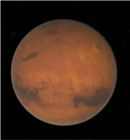
Project Daedalus was being considered. The two main reasons why we aren't already out there are (1) current economy, and (2) cost versus benefit (known financial returns). Also, to some extent, I think the scientific community in general has shifted too far away from the observable universe. There is so much grant money spent on research into origins and biology, but barely any being spent on continuing our advance into space. The Columbia accident slowed things down a bit in terms of public interest, which can partially account for such laxity in regard to this endeavor. But, such is still possible under current technology. The interest in space needs to be regained. Not necessarily the alien aspect of that, though that would certainly be interesting, but just space travel and tourism itself. Wouldn't it be awesome to take a month long space cruise to Mars and actually set foot on another planet? Wouldn't it be awesome to explore the wonders of this solar system? Or even further? But here we sit, while we contemplate our navels.