
Atypical aspies




 27 May 2016, 3:17 pm

A room does not represent the whole of a house. A flower does not represent the whole typicality of the plant world, a planet doesn't represent the whole typicality of the universe, a man does not represent the whole of homo sapiens, behaviourists don't represent the whole of psychology, nor Lutherans the whole of religious belief, one shoe style doesn't fit all shapes of feet.
There are different and many competing theories about what factors count in determining the what and why of who we Aspergers people are, mainly disseminated by people who are not us, who are not interested in our input other than as passive data subjects. (Though Baron-Cohen very possibly more like us than he is represented, in the guise of the objective scientist, perhaps).
For any oppressed minority group, the development of self-generated knowledge, awareness, self-definition and self-perception are extremely important, forming a broader, deeper understanding of how the variety of minority lives are lived, felt and experienced. Without that basis, blanket acceptance of any outsider's theories about us need to be tempered with caution.
Othering, stereotypes and myth are very real forms of oppression. Simon Baron-Cohen, in my own view, has been a significant contributor to their sustenance, though it is your right OP to view his theories as fact if you wish, and to stick with it as a means of self-understanding. Good for you! However imposing that on others within the context of a neurodiverse community is likely to generate not light but heat, and you risk being misunderstood as saying that anyone who doesn't fit Baron-Cohen's theory is not a fully 'real' aspie. I hope you are not thinking nor meaning that.
 27 May 2016, 3:31 pm
I don't think there is a typical aspie either.
There are different and many competing theories about what factors count in determining the what and why of who we are, mainly disseminated by people who are not us, who are not interested in our input (other than as data subjects). (Though Baron-Cohen very possibly is like us, in the guise of the objective scientist, perhaps).
For any oppressed minority group, the development of self-generated knowledge, awareness, self-definition and self-perception are extremely important, because they are a broader and deeper than the confining stereotypes and myth which stem from the tyrannical dominance of the majority group's normal.
Othering, stereotypes and myth are a very real forms of that oppression. Simon Baron-Cohen, in my own view, has been a significant contributor, though it is your right to view his theories as fact as you wish, though seeking to rigidly impose that on others within the context of a neurodiverse community is likely to generate not light but heat.
I personally, don't believe in his E-S theory especially in relation to autism or gender he is too reductionist taking something complex and reducing it to extremes of scores on a psychometric test. I think it stereotypes not just autistics but everyone too with confining believes about how an individual should behave and think I.e. with gender
I much prefer the intense world theory by Henry Markram and kamilla Markram et al. Because it is a bottom up approach, which allows for nuances in individual neural micro circuits. In many ways it highlights how we are all very different because it highlights the effects of overconnectivity for the autistic experience and therefore allows these difference to not just be neurodiverse but also different for each Individual, shaping our own autistic experiences!
However, that's not to say it doesn't have flaws, like using valproic acid on rats prenatally to create autistic-like offspring, not only can it not be said to be conclusively autism in humans but also Valproic acid is an identified risk factor but not the whole picture. Of course it looks at the autistic experience as a medical problem which is a problem. But it does help in dispelling myths like us not having feelings or being indeed empathetic, basically the premise is we all develop similarly but differently to cope with overwhelming sensory experiences, allowing for all types of people.

_________________
So Empathetic I am Autistic
 27 May 2016, 3:45 pm
Flyswine - it's difficult to profess that there is even a typical human, let alone a typical aspie. We can see prevailing trends among large population groups, but the closer you get to the individual level it becomes increasingly impossible to develop any sort of normalcy. The difficulty with your question is that there is no agreed upon "typical"; and when asked, an individual will compare themselves to their own abstraction of what "typical" is - often polarizing themselves. Of which the end result holds little basis for argument or empirical conclusion.
I'm not quite sure what your goal is in this discussion, though. Are you attempting to create a "cookie cutter" aspie using statistical trends? If so, I certainly hope you are able to accept the limitations of such an endeavor.
_________________
Outdoor enthusiast, engineering student, & local champion of social awkwardness.
Also, a newbie blogger:
www.aspieadventure.org
www.facebook.com/aspieadventure
 27 May 2016, 4:23 pm
There are different and many competing theories about what factors count in determining the what and why of who we Aspergers people are, mainly disseminated by people who are not us, who are not interested in our input other than as passive data subjects. (Though Baron-Cohen very possibly more like us than he is represented, in the guise of the objective scientist, perhaps).
For any oppressed minority group, the development of self-generated knowledge, awareness, self-definition and self-perception are extremely important, forming a broader, deeper understanding of how the variety of minority lives are lived, felt and experienced. Without that basis, blanket acceptance of any outsider's theories about us need to be tempered with caution.
Othering, stereotypes and myth are very real forms of oppression. Simon Baron-Cohen, in my own view, has been a significant contributor to their sustenance, though it is your right OP to view his theories as fact if you wish, and to stick with it as a means of self-understanding. Good for you! However imposing that on others within the context of a neurodiverse community is likely to generate not light but heat, and you risk being misunderstood as saying that anyone who doesn't fit Baron-Cohen's theory is not a fully 'real' aspie. I hope you are not thinking nor meaning that.
I agree. It is possible to gather data and make valid and true correlations, as they do actually exist & we wouldn't have a diagnosis without it. But the "best 7 of 12 symptoms" diagnosis style of autism is used because there is so much variation and diversity among us that any one stereotype will by necessity be inaccurate. But that doesn't stop NT people from portraying us that way, and whenever an oppressed group of "other" is publicly portrayed as a single distilled stereotype it makes it much harder to gain acceptance, as it is usually the most "othering" traits that are used to craft that single image.
_________________
“For small creatures such as we the vastness is bearable only through love.”
―Carl Sagan
 27 May 2016, 10:57 pm
Talking about your interests is NOT in anyway a criteria for autism, it's just something some people on the spectrum with less social inhibition do before they know better.
You clearly know very little about autism. Technically someone doesn't even need special interests or routines to be diagnosed with autism, as that's only two of the four or five B criterion for autism, and only two of them are needed for diagnosis. Also, to imply that because someone doesn't have problems in those two areas means they aren't impaired is extremely offensive. While my aspergers is extremely mild in terms of those, there are still aspects of it that definitely make a huge impact on my life (nowadays mainly in regards to executive functioning, which is often overlooked). The fact is learning to talk about any subject is a social skill most people, autistic or not, can learn how to do, it just takes time to build up the knowledge base and practice the social mechanics. Someone does not cease to autistic once they learn that social skill. Also, the usual problem for people on the spectrum isn't that their routines interfere with daily function, but having their routines DISRUPTED interferes with functioning.
It's a tendency of autism as a whole, meaning it's not a specific personality characteristic required for autism. The fact is EVERYONE collects and categorizes information, what differs from person to be person is what things they like collecting information the most about. For example, people who like people collect and categorize a lot of information about people, and than should in turn raise ones EQ and not their SQ despite being a systematizing process. What makes the process autistic is the intensity, if you're REALLY interested in something, than yeah, you're going to collect and categorize a lot of information about it in one way or another.
Something like a 27, still more than the average NT, but well below the average for aspies. I know a woman who is very adamant that she is NOT autistic, as all her psychologists said she isn't (I'm still a bit skeptical on this, as psychologists tend to not recognize autism in women, but okay), but she scored like a 49 on it. I think Baron-Cohen's theory just sucks. We scored more similarly on the aspie quiz (she slightly below average on both aspie and nt score, me slightly above average in both categories), and I think it's a bit more accurate.
viewtopic.php?p=2497167
no one scored higher on empathising than systemysing
Actually, I did, and several other people might of, they just put balanced rather than female, you can't tell from the poll results. I didn't vote in the poll back in 2011, but I did before you wrote that post. That poll doesn't mean as much as you seem to think it means. Part of the problem is that there are numerous questions on the EQ test which people on the spectrum tend to score poorly on as it directly relates to the condition when in general they aren't unempathetic. The poll didn't ask for people's SQ score, it asked for the relative balance, so if so someone scores a low EQ but a normal SQ than they'd come out as having an "extreme male brain", which is a ridiculous conclusion BTW. The other problem is the way the poll was presented led to some bias in the results as people with an ES personality are probably more likely to be drawn to a forum like this (especially back in 2009 when there was less people challenging the EQ/SQ theory, so most the people not diagnosed as autistic who came to this site speculating they had autism would be the type who more fit the stereotype), the actual researchers found only an 65% ES versus the 85% ES found here.
_________________
Cinnamon and sugary
Softly Spoken lies
You never know just how you look
Through other people's eyes
Autism FAQs http://www.wrongplanet.net/postt186115.html
 30 May 2016, 9:58 am
What do you mean by best 7 of 12 symtpoms?
And I'm well aware that no two persons are alike, but Asperger is a syndrome, and a syndrome has a specific set of impairments, otherwise it wouldn't be a syndrome. So my questions is, what is it that all aspies have in common?
 30 May 2016, 11:32 am
It's impossible to have autism and not have any social impairments. It's impossible to have autism and not have any some sort of repetitive and restrictive behaviors. Look at the DSM 5 criteria and the DSM IV.
_________________
Son: Diagnosed w/anxiety and ADHD. Also academic delayed and ASD lv 1.
Daughter: NT, no diagnoses. Possibly OCD. Is very private about herself.
30 May 2016, 11:40 am
And I'm well aware that no two persons are alike, but Asperger is a syndrome, and a syndrome has a specific set of impairments, otherwise it wouldn't be a syndrome. So my questions is, what is it that all aspies have in common?
Perhaps it is the deep feeling of being different from other people, but if you are looking from a medical or psychological standpoint then I think to answer hollistically all the possible symptoms and variations of these symptoms and the combinations of these symptoms, the causation all contribute to creating an identifiable autistic experience from an inside and outside perspective that is either quantitatively or qualitatively identifiable to the person and the clinician, autistic. So in short its actually quite subjective and with say MRI Technology diagnosed individual might not show any difference from neurotypicals.
Does this mean they are autistic? Maybe not? So autism is as much a social construct as it is an expression of human variation, disabling to some but maybe to not to others. Put it this way if Autism didn't exist would we have developed the medical criterion of defecits to diagnose it, maybe not and conversely if everyone was autistic we would simply see every other normal autistic person as being normal in their own individuality. So perhaps I'm afraid the typical autistic is a social construct created by neurotypicals to describes clusters of behaviour which indicate an apparent deficit to them, at least for them. Put it this way if somehow in the opposite situation an autistic community would generate diagnostic criteria to describe neurotypicals, but relating to the real world how can we say that this group has to have common features to indicate it's existance, because it does exist and it seemingly views variation as charactersitc of its humanity while expecting people are autistic to be ironically rigid in experession.
Even though yes it is much a medical disability to many the causation is so very varied that it has a potential to express autistic variation in a similar way normal variation is found in a neurotypical population
Rant of digressions over!

_________________
So Empathetic I am Autistic
30 May 2016, 11:25 pm
NOTHING. That's the killer revelation of the century, and it's actually been known for sometime. LegacyGirl is correct in that it requires a combination of social and restrictive impairments, but those aren't any specific trait, and they don't have any specific cause. There isn't autism, but autisms, the hard part is differentiating them.
_________________
Cinnamon and sugary
Softly Spoken lies
You never know just how you look
Through other people's eyes
Autism FAQs http://www.wrongplanet.net/postt186115.html
30 May 2016, 11:38 pm
ASD people have a lot in common really - 1) we are all not neuro-normative and 2) we are discriminated against at a structural level (eg job interviews are biased in favour of NT communication styles) and 3) we all have to contend with stigmatising and simplistic myths which abound on the net, in the media, a form of almost daily assault on psychological and emotional levels, and 4) we are poorly catered for by all major institutions - health, educational, political, media and other service providers.
31 May 2016, 1:44 am
if even not your standard,
why should it be disabling? what is disabling, that should be decided upon by "people who get payed for that"
i dont know about fear (the shared, consensus-seeking fear, the talking point and justification by numbers)
-all i see from foggy outlook is not wising up with age, but entrenching in habits, as if, (and indeed it does, seen like that,) all that matters is judging *long ago i called it mengingitis , mening=opinion, opinionitis<being fed by news&opinions in a near-constant way io to process everything to a judgement
nt's fear everything, thinking most, or independent thinking specifically
most (think)time is past with fears, how do i look, what will the others think?
i don't know how it is to be so fearfull of yourself at fulltime occupation
the most fearfull seek to dominate, actually it looks like collective drowning, climb on whatever to stay above water even if it's pushing under others ......
or like the screaming nonsense, apewise!!
constant validation and autoloop of wrong behaviour imo
last time at the zoo,who are dumb, a thousand facepalms for humanity 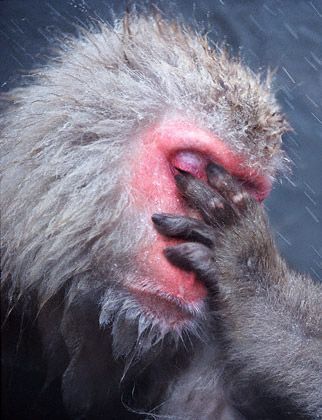
somewhere hidden in plain sight, there's an agreed-upon fake that has to be maintained, at any price
 31 May 2016, 2:15 am
The only semi-geeky special interest I ever had was the planets, and I wasn't really interested in them in a very geeky way as I made up an imaginary world where the planets were humanized and this was the primary focus. Also, games with the planets were big. And this only lasted about a year.
Other interests have been BC Ferries, Roller Coasters and Great Big Sea (a band that has now broken up  )
)
I currently don't have any special interests and haven't since I was about 17, but I like psychology and politics quite a bit. Also, I like the The Sims, which I guess is slightly geeky, but it's not really that geeky of video game compared to many others.
_________________
-Allie
Canadian, young adult, student demisexual-heteroromantic, cisgender female, autistic
31 May 2016, 4:03 am
NOTHING. That's the killer revelation of the century, and it's actually been known for sometime. LegacyGirl is correct in that it requires a combination of social and restrictive impairments, but those aren't any specific trait, and they don't have any specific cause. There isn't autism, but autisms, the hard part is differentiating them.
so if you are not troubled that much in the social area nor in the restrictive one, then what are the main issues aspergers brings to your life?
03 Jun 2016, 5:26 pm
NOTHING. That's the killer revelation of the century, and it's actually been known for sometime. LegacyGirl is correct in that it requires a combination of social and restrictive impairments, but those aren't any specific trait, and they don't have any specific cause. There isn't autism, but autisms, the hard part is differentiating them.
so if you are not troubled that much in the social area nor in the restrictive one, then what are the main issues aspergers brings to your life?
I WAS troubled more in those areas in the past, STILL have symptoms in those areas. Main trouble I have with nowadays is with executive functioning.
_________________
Cinnamon and sugary
Softly Spoken lies
You never know just how you look
Through other people's eyes
Autism FAQs http://www.wrongplanet.net/postt186115.html


