
Machine learning identifies FOUR autism subtypes




 08 Apr 2023, 6:24 pm

Edna3362 wrote:
Quote:
Also, when I had my DNA tested, I got this warning, I wonder if it's relevant to autism:
you may need to monitor your carbohydrates & sugar intake more closely.
Your genetic results suggest you may be at a disadvantage when it comes to breaking down carbohydrates and sugars, affecting your blood glucose regulation.
you may need to monitor your carbohydrates & sugar intake more closely.
Your genetic results suggest you may be at a disadvantage when it comes to breaking down carbohydrates and sugars, affecting your blood glucose regulation.
I never had any DNA tests.
But my SPED teacher believes this statement applies to all cases of neurodivergence -- that eating too much carbs and sugar 'worsens' an individual's respective diagnosed 'symptoms', more notable behaviors, interfering learning and progress of therapy.
She calls it 'ND version of drunkenness'.
Worse case scenario would be regression -- based on her 20 years of experience. So she advises all parents' to strictly regulate sweet intake.
Whether it's ADHD, ASD, or any forms or LD... And age didn't matter either.
And advices the same to me -- though it aligns with my goal as someone with a family history of diabetes.
I'm still working on it. Among other things I'm trying.
Interesting. I often used to gobble up sugar during my childhood and youth, and never once noticed a problem after doing it. Later on I largely ditched sugar because the health people frown on it so much. These days I still get quite a lot of carbohydrate though, mostly from potatoes, raisins, wholemeal flour, and other vegetables. When I indulge in commercially-made biscuits (cookies) these days, I tend to feel a bit sick if I overdo it, but I always put that down to the suspicion that manufactured foods are generally somewhat toxic in one way or another. But I've not noticed any conclusive associations between my diet and my ASD traits, and even the physical responses don't seem to correlate very strongly to what I eat. Of course there's a limit to the experiments I'm happy to do these days, as being rather health-conscious in general I tend to stick to what's generally thought to be healthy food, and I don't eat an awful lot normally.
 08 Apr 2023, 6:29 pm
Recidivist wrote:
IsabellaLinton wrote:
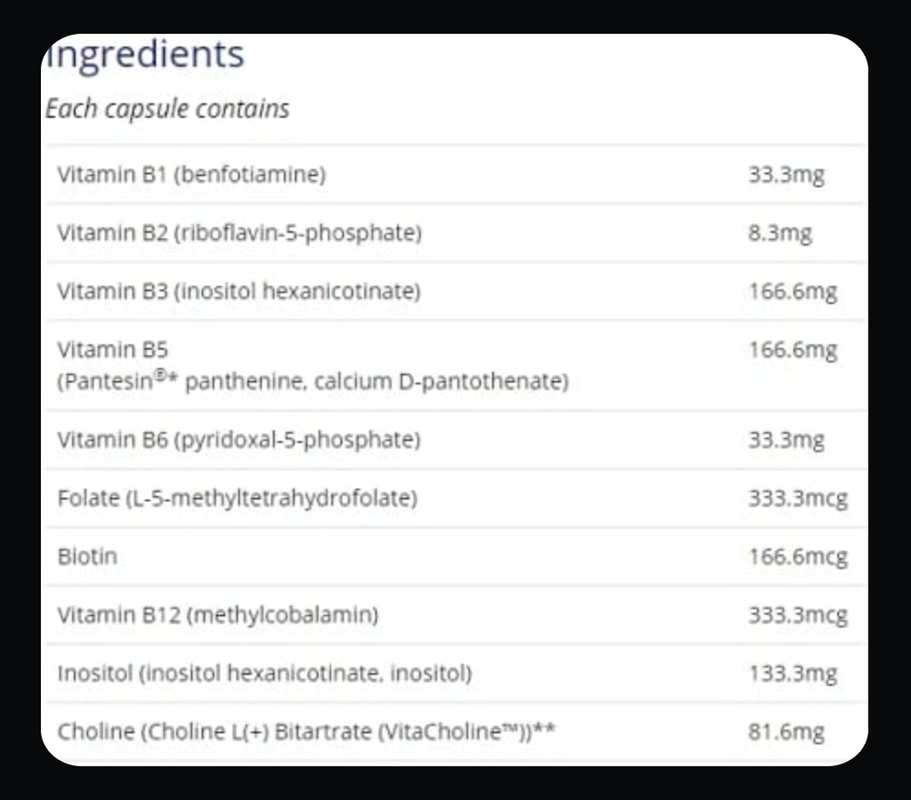
I couldn't get the list of active ingredients.
Quote:
Each 15ml tablespoon
Vitamin B1 (thiamine hydrochloride) 25mg
Vitamin B2 (riboflavin-5-phosphate) 20mg
Vitamin B3 (inositol hexanicotinate) 100mg
Vitamin B5 (Pantesin®*, calcium D-pantothenate) 300mg
Vitamin B6 (pyridoxal-5-phosphate) 50mg
Folate (L-5-methyltetrahydrofolate) 100mcg
Biotin 25mcg
Vitamin B12 (methylcobalamin) 1000mcg
Inositol (inositol hexanicotinate) 100mg
Choline (L(+) Bitartrate (VitaCholine™)** 200mg
*Pantesin® is a registered trademark of Kyowa Pharma Chemical Co., Ltd. ** VitaCholine™ is a trademark of Balchem Corporation
Non-Medicinal Ingredients
Natural blueberry flavour, natural flavour, xanthan gum, acacia gum, citric acid, purified water, stevia, glycerine, potassium sorbate, maltodextrin.
 Thanks!
 I tried taking pictures but it kept blurring between the rounded bottle and the small print. I was too lazy to search for it online but I should have done that in the first place.
_________________
I never give you my number, I only give you my situation.
Beatles


 08 Apr 2023, 7:13 pm
Quote:
Vitamin B1 (thiamine hydrochloride) 25mg
Vitamin B2 (riboflavin-5-phosphate) 20mg
Vitamin B3 (inositol hexanicotinate) 100mg
Vitamin B5 (Pantesin®*, calcium D-pantothenate) 300mg
Vitamin B6 (pyridoxal-5-phosphate) 50mg
Folate (L-5-methyltetrahydrofolate) 100mcg
Biotin 25mcg
Vitamin B12 (methylcobalamin) 1000mcg
Inositol (inositol hexanicotinate) 100mg
Choline (L(+) Bitartrate (VitaCholine™)** 200mg
Vitamin B2 (riboflavin-5-phosphate) 20mg
Vitamin B3 (inositol hexanicotinate) 100mg
Vitamin B5 (Pantesin®*, calcium D-pantothenate) 300mg
Vitamin B6 (pyridoxal-5-phosphate) 50mg
Folate (L-5-methyltetrahydrofolate) 100mcg
Biotin 25mcg
Vitamin B12 (methylcobalamin) 1000mcg
Inositol (inositol hexanicotinate) 100mg
Choline (L(+) Bitartrate (VitaCholine™)** 200mg
Fascinating. These are the amounts I'm getting:
B1 3mg
B2 3mg
B3 3mg
B5 3mg
B6 3mg
B7 3ug
B9 20ug
B12 3ug
To that I add a further 6.5ug of B7. Doses calculated from RDA values minus estimated normal intakes from food. Sources are "NOW B-100" capsules and "Nutricost biotin" capsules:
https://www.amazon.com/NOW-Vitamin-B-10 ... B000UX110A
https://www.amazon.com/Nutricost-Biotin ... B01AMJCHB8
They both contain way more than what I use per day, so I open the capsules and make a calculated dilution of them in dried chick pea flour, done such as to give me what I need in 200mg of that powder per day. Works out at 3% of a B-100 capsule and a staggeringly tiny 0.065% of a B7 capsule. It was a hassle to get all the sums right but now that's all done it's really quite easy, and at those doses, costs very little. I just add the powder to a meal, as I generally prefer not to take supplements on an empty stomach.
According to my notes, most B vitamins are safe at much higher doses but the safe limit for B3 is thought by nal.usda.gov to be 35mg, and 100mg for B6. That would put your B3 above what the USDA recommends, but I'm never sure how seriously to take those things, though for my own use I try to stay below any hint of danger. I don't know why so many supplements contain such high doses as they do, if they're intended for the general population, but I presume if they were really dangerous then they'd not be allowed to sell them. And it's been very helpful to me that they're so strong. Supplements aren't cheap, so if the strong ones are diluted, it can bring the costs down a lot.
I'm not saying I'm right, or that others should do as I do. In my own case I'm presuming myself to be "well until proven unwell," which might turn out to be quite wrong. It's a shame there isn't a cheap, convenient test for these things, or I'd be onto it like a shot.
08 Apr 2023, 7:26 pm
The numbers on mine are higher than you quoted, and my doctor said I should take three per day.
I don't, but she said it was OK.
I'm not saying I'm right or wrong either, it's just interesting.
Admittedly my regular diet is probably nowhere near as good as yours.
I just had a bowl of ice cream for dinner. 
_________________
I never give you my number, I only give you my situation.
Beatles
 08 Apr 2023, 8:30 pm
Did anyone glean what the actual four subtypes are?
_________________
The mere fact that science may not yet adequately explain an object, event, or experience does not mean the immediate explanation should automatically default to a conspiratorial, extraterrestrial, paranormal, or supernatural cause.
 08 Apr 2023, 8:58 pm
Let's see...
Article says;
Quote:
... unravel the heterogeneity of autism and define more biologically associated subtypes ...
It's not necessarily meant 'by traits' or 'by common behaviors' but it can said traits can be more explained by the biology.
These are the traits measured:
Quote:
Their machine-learning technique identified three roughly orthogonal brain-connectivity scores that did the best job of predicting the mix of someone’s verbal intelligence, social affect and repetitive behaviors. The social affect dimension, for instance, ended up being closely linked to connectivity among brain regions associated with social and emotional processing. The verbal intelligence dimension, meanwhile, was associated with connectivity among brain areas related to reading and language.
This is the subgroup that stims a lot and may or may not likely have ADHD or OCD comorbidities, may or may not have a more serious sensory processing issue, and likely live in extremes of lows and highs.
Quote:
In one subgroup, which was characterized by people with high levels of repetitive behaviors, brain activity patterns correlated with decreased expression of the gene HTR1A, which encodes a serotonin receptor and has been previously linked to autism.
This is the subgroup that probably started the 'autistics lack of empathy/emotion' trope, the 'refrigerator mother' stereotype, likely populated by alexithymics.
Quote:
Another subgroup, which was most challenged in terms of social affect, was associated with the oxytocin receptor. The researchers say they hope to reanalyze data from a failed clinical trial of oxytocin therapy to see if there are indications that it was beneficial for this particular subgroup.
The other two is not stated.
Unknown. I'll take a guess; since I'm not patient.

Derived by the triad of impairments (as the dimensions are measured by verbal intelligence, social affect and repetitive behaviors); if social imagination is based on the group with social affect issues, if repetitive behaviors is based on the group with high repetitive behaviors (duh
), then the possible third type would be equivalent to social communication challenges?Communication challenged is unstated.
Likely populated by anyone with any degree of aphasia -- issues with verbal intelligence or/and learning disabilities, which may translate to an even more differences in communication.
Likely living in chronic stress or/and may or may not have history of cerebral blood flow/oxygen breathing issues one way or another, likely easily vulnerable to anomic aphasia.
I guess the 4th type is 'combined'. Or, 'uncategorized'. Possibly a more complicated biological mechanism or even neurological anatomy.
But since it's in progress, maybe that can be split in different categories itself.
Again this is a guess. For fun and time killing.
ToughDiamond wrote:
Edna3362 wrote:
Quote:
Also, when I had my DNA tested, I got this warning, I wonder if it's relevant to autism:
you may need to monitor your carbohydrates & sugar intake more closely.
Your genetic results suggest you may be at a disadvantage when it comes to breaking down carbohydrates and sugars, affecting your blood glucose regulation.
you may need to monitor your carbohydrates & sugar intake more closely.
Your genetic results suggest you may be at a disadvantage when it comes to breaking down carbohydrates and sugars, affecting your blood glucose regulation.
I never had any DNA tests.
But my SPED teacher believes this statement applies to all cases of neurodivergence -- that eating too much carbs and sugar 'worsens' an individual's respective diagnosed 'symptoms', more notable behaviors, interfering learning and progress of therapy.
She calls it 'ND version of drunkenness'.
Worse case scenario would be regression -- based on her 20 years of experience. So she advises all parents' to strictly regulate sweet intake.
Whether it's ADHD, ASD, or any forms or LD... And age didn't matter either.
And advices the same to me -- though it aligns with my goal as someone with a family history of diabetes.
I'm still working on it. Among other things I'm trying.
Interesting. I often used to gobble up sugar during my childhood and youth, and never once noticed a problem after doing it. Later on I largely ditched sugar because the health people frown on it so much. These days I still get quite a lot of carbohydrate though, mostly from potatoes, raisins, wholemeal flour, and other vegetables. When I indulge in commercially-made biscuits (cookies) these days, I tend to feel a bit sick if I overdo it, but I always put that down to the suspicion that manufactured foods are generally somewhat toxic in one way or another. But I've not noticed any conclusive associations between my diet and my ASD traits, and even the physical responses don't seem to correlate very strongly to what I eat. Of course there's a limit to the experiments I'm happy to do these days, as being rather health-conscious in general I tend to stick to what's generally thought to be healthy food, and I don't eat an awful lot normally.
Mine is very much executive functions itself than ASD at all. More like ASD worsens as EF worsens because I need the latter to compensate well.
And diabetic like symptoms directly affects EF.
It's more or less the same with me in my youth.
Except there are plenty more to account to -- having untreated chronic inflammation to the face sinusitis and sleep issues that caused it.
In turn gave me a lot of stress on top of other things to a point that I barely can distinguish between stressed and not stressed.
The fluctuations and luck was the only way I get to comprehend the contrast.
Turning to comfort food became this coping mechanism. Now that I'm trying to cut that, I'm not sure what to replace it with.
Working out doesn't release stress in my case -- I'm habitually active, yet I couldn't seem to improve... Slow and gradually getting worse. It says it's 'aging'...

Heck, I'm already slacking off and eating a lot of meat (which I still like to do) to make up for the poor sleep and active lifestyle.
It doesn't improve much of a thing... It slows something down at best.
Well, unless one is having 'aging symptoms' since around puberty, then I'll still just gamble my way into improving.

_________________
Gained Number Post Count (1).
Lose Time (n).

Lose more time here - Updates at least once a week.
09 Apr 2023, 1:20 am
IsabellaLinton wrote:
The numbers on mine are higher than you quoted, and my doctor said I should take three per day.
I don't, but she said it was OK.
I'm not saying I'm right or wrong either, it's just interesting.
Admittedly my regular diet is probably nowhere near as good as yours.
I just had a bowl of ice cream for dinner.
I don't, but she said it was OK.
I'm not saying I'm right or wrong either, it's just interesting.
Admittedly my regular diet is probably nowhere near as good as yours.
I just had a bowl of ice cream for dinner.
It's a complicated subject. For B3 at least, it depends to a degree on the form of the vitamin. They generally suggest that these supplements shouldn't be used without medical supervision, though at my tiny doses that doesn't worry me. For the high doses a trustworthy expert seems like a good move, if such a beast can be accurately identified.
When I studied nutrition (as an amateur), I noticed some controversy among the professionals (some even think the current RDA for sodium is dangerously low, and have data to support their notion), and recommended intakes tend to change over the decades as more is found out. A few of my vitamin and mineral intakes had been alarmingly low compared to the RDAs for many years before I corrected them, yet there I was, still walking about, with no known serious health problems, and I have no conclusive empirical evidence that my interventions are doing any great good, though I'm less worried about possible deficiencies and I suspect I feel a tad better overall than I used to. Certainty doesn't enter into this game.
09 Apr 2023, 1:43 am
Edna3362 wrote:
Mine is very much executive functions itself than ASD at all. More like ASD worsens as EF worsens because I need the latter to compensate well.
And diabetic like symptoms directly affects EF.
It's more or less the same with me in my youth.
Except there are plenty more to account to -- having untreated chronic inflammation to the face sinusitis and sleep issues that caused it.
In turn gave me a lot of stress on top of other things to a point that I barely can distinguish between stressed and not stressed.
The fluctuations and luck was the only way I get to comprehend the contrast.
Turning to comfort food became this coping mechanism. Now that I'm trying to cut that, I'm not sure what to replace it with.
Working out doesn't release stress in my case -- I'm habitually active, yet I couldn't seem to improve... Slow and gradually getting worse. It says it's 'aging'...
Heck, I'm already slacking off and eating a lot of meat (which I still like to do) to make up for the poor sleep and active lifestyle.
It doesn't improve much of a thing... It slows something down at best.
Well, unless one is having 'aging symptoms' since around puberty, then I'll still just gamble my way into improving.
And diabetic like symptoms directly affects EF.
It's more or less the same with me in my youth.
Except there are plenty more to account to -- having untreated chronic inflammation to the face sinusitis and sleep issues that caused it.
In turn gave me a lot of stress on top of other things to a point that I barely can distinguish between stressed and not stressed.
The fluctuations and luck was the only way I get to comprehend the contrast.
Turning to comfort food became this coping mechanism. Now that I'm trying to cut that, I'm not sure what to replace it with.
Working out doesn't release stress in my case -- I'm habitually active, yet I couldn't seem to improve... Slow and gradually getting worse. It says it's 'aging'...
Heck, I'm already slacking off and eating a lot of meat (which I still like to do) to make up for the poor sleep and active lifestyle.
It doesn't improve much of a thing... It slows something down at best.
Well, unless one is having 'aging symptoms' since around puberty, then I'll still just gamble my way into improving.
It's amazing how different individuals' experiences can be. My own physical and psychological state has for decades been remarkable for its stability. Beyond a few minor and often transient things, it hardly seems to matter what I eat or what I do with my lifestyle in general, I remain like a raft, feet always a bit wet but never sinking. Things get a little bit better or worse, but not greatly so.

 09 Apr 2023, 6:06 am
Fnord wrote:
Did anyone glean what the actual four subtypes are?
I scanned ( speed read) the research and the subgroups are only named 1-4. Three brain behaviours ( social affect symptoms, restricted and repetitive behaviors (RRBs) and verbal IQ ) are compared via different methods ( data sets, neuroimaging , gene comparison etc)
).
I know you probably didn't want to download the research , do you want me to post it (maybe in it's own thread as it's rather long)
_________________
Another man's freedom fighter, one man's terrorist is - Yoda (probably)
09 Apr 2023, 6:12 am
The only reason I cannot download the research myself is that I live in the Philippines, where my electronic payments to places outside the country are automatically flagged and blocked.
_________________
The mere fact that science may not yet adequately explain an object, event, or experience does not mean the immediate explanation should automatically default to a conspiratorial, extraterrestrial, paranormal, or supernatural cause.
09 Apr 2023, 6:42 am
Recidivist wrote:
^ Sorry for guessing the reason wrong. As you didn't answer my question, I'm guessing that's a 'No'.
While I would like to read the study for myself, a wordwall would be tedious.Thank you, but no.
_________________
The mere fact that science may not yet adequately explain an object, event, or experience does not mean the immediate explanation should automatically default to a conspiratorial, extraterrestrial, paranormal, or supernatural cause.
| Similar Topics | |
|---|---|
| I feel like I entered a time machine |
10 Aug 2026, 11:28 am |
| Re-learning math to prepare for college. |
10 Aug 2026, 7:25 pm |
| Learning disorder and Depersonalization-derealization |
28 Jun 2026, 6:03 pm |
| Having Autism |
27 Jul 2026, 3:08 pm |


