Are Sensory Hyper sensitives more likely to suffer fatigue
Hey,
After reading up about Autistic Fatigue and Burnout (which i realise I suffer from)
I have been contemplating as to whether people with ASD who suffer from Sensory impairment are more
likely to suffer from burnout / fatigue than other ASD sufferers.
Although I understand that the frustration us guys with ASD have with communication, reading body language, regulating emotion and other areas of life are also likely a major cause of fatigue too.
I do not know that many people with ASD who suffer from sensory overload nor Autistic Fatigue.
So I thought i would ask to see what the consensus of opinion is with regards to what others experiences have been on the subject.
I'm diagnosed with Sensory Processing Disorder and I suffer severe sensory overload (and underload, which is a distinct matter). I've been working intensively with an Occupational Therapist for SPD and Interoception, doing up to 20 hours a week of homework and therapy last summer.
I burn out very easily into shutdown mode, but I've been in overall autistic burnout for many years now.
_________________
I never give you my number, I only give you my situation.
Beatles
Hi Isabella
Thanks for your reply and very interesting the info you have given.
I think i suffer from the same problems, however, in the area that i live SPD isn't a recognised condition.
The UK is behind in their knowledge, and where i live (which is a tiny island off England / France), is
even more behind than the UK. So we get the developments last.
But interesting the info you have given. I shall perhaps read up further.
To see if i can get the OTs in the island that I live on to take it into consideration.
Out of interest, i grew up in a house that was next door to a family who also had the same surname as you.
Perhaps a distant relative.
Linton isn't my real surname, but that's cool anyway! My ancestors are from a small hamlet called Linton, actually.
My sensory difficulties were noted by the neuropsych who did my ASD diagnosis, but then I was referred to OT for the additional diagnosis of SPD. I'll look up my notes for you. I have a copy of the assessment questionnaire but unfortunately it's in PDF and I've never been able to delete my name / responses from it to show others. The questions were extremely interesting, and actually made me cry. I had never stopped to appreciate just how pervasive my sensory issues have been throughout my life, or to what extent I was challenged.
Starting with Interoception and SPD in therapy allowed me to finally work on Executive Function. You can't work on cognitive adaptations until your limbic system is regulated. Who knew? lol
_________________
I never give you my number, I only give you my situation.
Beatles
Sure cool re your knowledge and Linton. I just looked it up quickly and it appears your family were originally from an area near Cambridge. I have been there a couple of times.
It has a very good reputation, especially for intellectual schooling.
As for SPD
you appear to have a good grasp of the subject
sounds like you have good medical pro's to help
something that i lack in the area that i live
which is a major concern, as when you suffer from something as complex as we do
it is hard to communicate the significance of this to people who are involved with assessing a persons
level of disability especially with terms on what impact the problems cause in normal life and a persons ability to
work
Thanks for offering to look up the info on your diagnosis questionnaire
although I am afraid i don't think it will help
as not many of the medical pro's in the island that i live are receptive to the client referring them to info
in my experience, most of the medical professionals in the area that I live are very stubborn and do only
what they have to, to get paid
they are rarely pro-active with regards to learning
and in some cases, individuals get victimised within the medical system
at present, the general medical doctors look after their own training
and there are no specialist doctors on the island who specialise in Autism Spectrum Disorder
which leaves all the assessments to be done by people who don't have a clue (and in some cases don't even recognise or acknowledge the condition exists!)
which usually results in the disabled person with ASD being forced into employment and circumstances that will make them ill
presently a system that i am trying to change
but hard, when you try and change a system on your own without funding, lawyers or help
and while you are suffering from the condition at the same time
but never mind
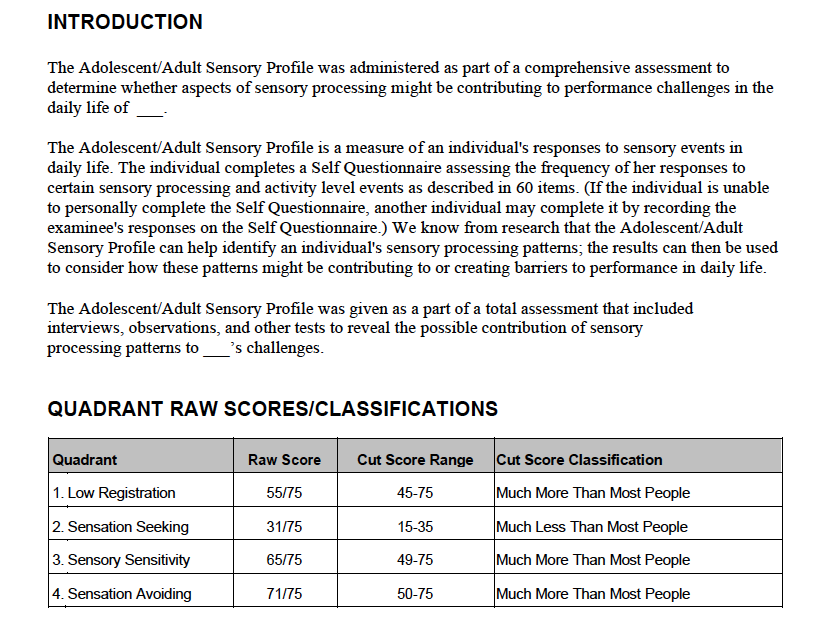
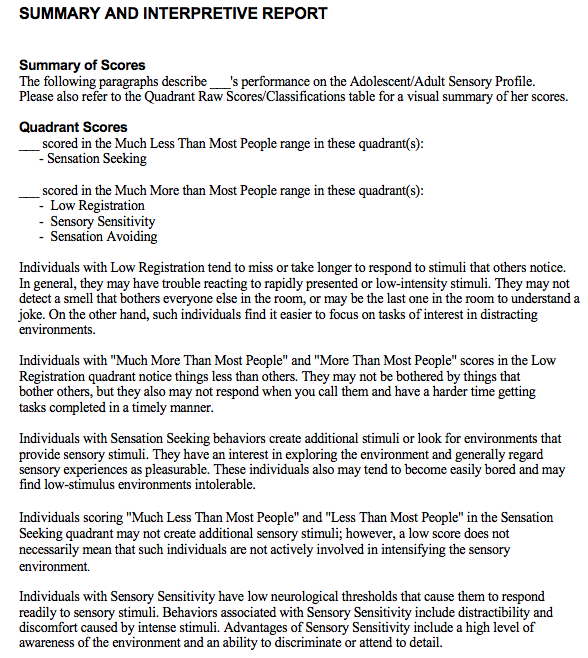
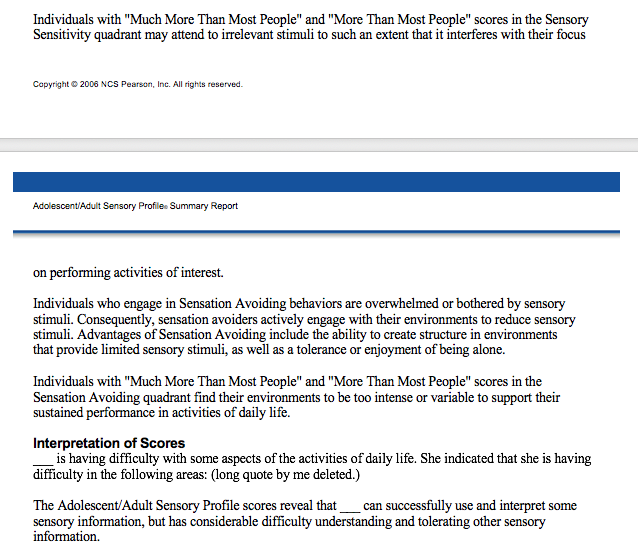
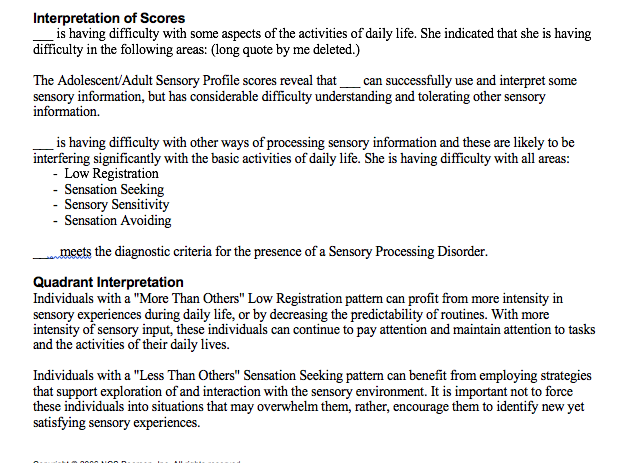
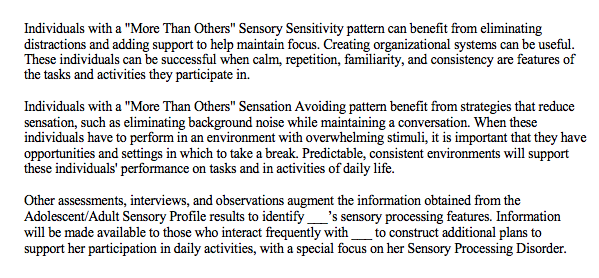
Here's the preamble of my report.
I do have the questionnaire questions, but like I said they have all my responses filled in and I don't know how to delete them? I thought you may find this summary interesting, though.


_________________
I never give you my number, I only give you my situation.
Beatles
I'm so sorry to read of the lack of services in your area.
To answer your original question, yes sensory overload leads to hyperstimulation and dysregulation of the nervous / limbic system. This exhaust the body's resources of adrenaline and stress hormones, because you are always in a fight, flight, or freeze (shutdown) mode.
I don't want to endorse any specific therapy, but you might find this work about Polyvagal Theory helpful. There's a program you can follow online, if you find it interesting. It was developed for people with PTSD/ASD, but it contains a lot of useful practice for sensory regulation as well. I'd actually argue that SPD can create a form of PTSD for people, because of our constant need for hyper-vigilance pertaining to environmental safety.
https://integratedlistening.com/blog/20 ... r-houston/
Click on the video in this link. It's really informative!
_________________
I never give you my number, I only give you my situation.
Beatles
Hi Isabella,
Thanks so much for posting parts of your questionnaire and for your advice with regards to therapy.
Much appreciated.
Sure re my area. Not really sure what to do with them, as they aren't very receptive with regards to changing the way they operate. The people who are employed, get a wage, they turn up, do enough to get their wage, and little else.
In the UK there also can be a kind of get on with it type of attitude, where people think you should just soldier on regardless as to what your problem is in life. Only those who are really up on the knowledge in the area really know what they are talking about and are able to advise.
Incidentally, Cambridge (UK) is the location of the Autism Research Centre and an Autism Centre of Excellence, which appears to be at the forefront in advice for all things ASD.
Sadly, the people in the medical community in the area that I live are not connected to this service and pretty much
run independently. So we have to make do with what we get.
Which for low functioning people with ASD, is great. As they have specialist places for them to live in supported housing, loads of opportunities to socialise, lots of support for general living, and a general community that has been built up over many decades.
For people who have Asperger Syndrome or high functioning ASD / ASD without intellectual impairment.
We have the opposite, with some people such as those who suffer from hypersensitivities to sound
are left without aid, because the people involved in the medical care community who are paid to look after them
don't care basically. or because there aren't enough numbers for people who work in the industry to make them realise that it is a real medical condition, so they just ignore it.
But still, i will continue to try and battle on and see what i can achieve.
Thanks again for your help
cheers