
NVLD - bad, misleading, inadequate name




 12 Oct 2025, 9:12 am

Because they like to isolate us in one subhuman group and lump everyone else together as "normal".
("They" meaning just anyone).
_________________
My diagnosis story and why it was a traumatic experience for me:
viewtopic.php?f=35&t=416910&start=1056#p9695026
Please notify me if there's a spelling mistake or an obvious autocorrect error in my posts.
15 Oct 2025, 11:19 am
https://www.frontiersin.org/journals/ps ... 48074/full - Weak central coherence in neurodevelopmental disorders: a comparative study - NVLD+ADHD (but not ADHD without NVLD) and SCD appear to be surprisingly similar to ASD level 1 in this research. Fragment:
Conclusion: Central coherence deficit was not exclusive to ASD1: it also characterizes NVLD and SCD.
Other fragment (with own bolding and underlining):
 17 Oct 2025, 7:03 pm
I don't want to make it a "who has it worse" competition, but NVLD does especially suck because I give off the impression of being extremely intelligent because of my verbal skills, but as I got older, I started to struggle in school, and I just got the "not trying hard enough" accusations lobbed at me. No, I saw a math tutor every week and studied for hours and still failed Algebra II. That's not "giving no effort." NVLD is awful.
20 Oct 2025, 9:28 am
In this cross-sectional study including 180 children, 3 NVLD profiles emerged: (1) broad visual-spatial deficits with inattention, aggression, and poor reading comprehension; (2) isolated deficits in visual-spatial index, no math problems, high anxiety, and low specific learning disorder rates; and (3) deficits in Fluid Reasoning Index, math problems, and good reading skills. A fourth profile was characterized by broad, nonspecific weaknesses, spanning verbal and visual-spatial domains.
https://pmc.ncbi.nlm.nih.gov/articles/PMC12489661/
It is fascinating!! !
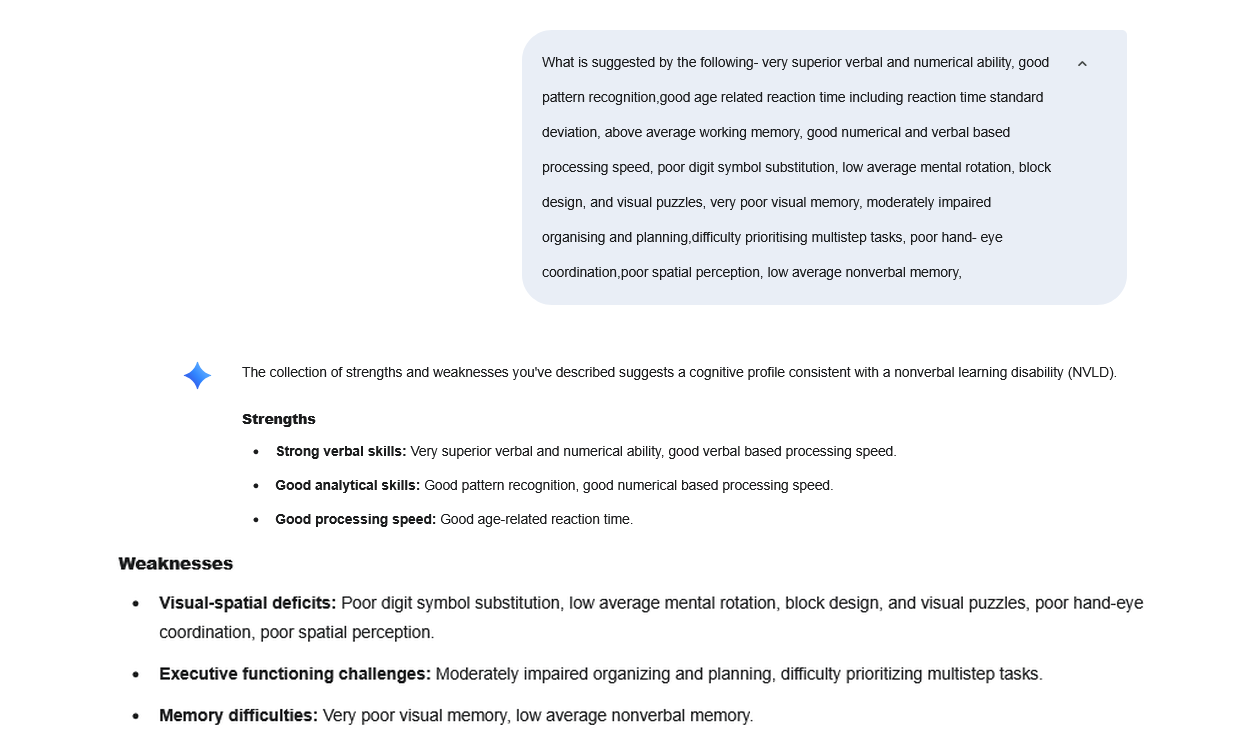
I read this article and I suppose that I have second profile with isolated deficit in visual-spatial index, no math problems, high anxiety and low specific learning disorder rate. This profile has deficit in POI/VSI in comparison to VCI and fine motor impairment. Arithmetic is good in this profile, unlike three other profiles mentioned in this article (on average math is about 1 SD better in second subtype than in three other NVLD subtypes). Fourth NVLD subtype might not be true NVLD (this with broad, nonspecific deficits). All four NVLD subtypes have weak executive functioning and relatively good reading skills. Fourth subtype on average has better VSI and FRI than VCI(!).

 20 Oct 2025, 10:08 am
Do you have aphantasia? ChatGPT said that aphantasia would be rather correlated with ASD than with NVLD.
I do not have aphantasia and probably even I do not have hypophantasia, but I think mostly in verbal or non-visual way. My rotation skills by forming mental visualizations are very bad. I can imagine pretty apple in my mind, I rather have phantasia than hypophantasia, although I do not generate so many images in my mind because I think mostly "verbally".
20 Oct 2025, 10:32 am
Do you have it since childhood?
I rather would say that I have autism and NVLD not just NVLD.
Did you have low birth weight, fetal growth restriction or preterm birth? I had LBW and FGR - I weighed 2150 g despite being born on time, maybe no earlier than in full 38th week of gestation, I had low ponderal index and my head circumference was about 4 cm larger than my chest circumference, so I had asymmetric FGR. There was an illness of the mother before my childbirth.
20 Oct 2025, 11:21 am
I just know I was above average weight when I was born, but not an outlier. I've never been assessed for NVLD. It took nearly 2 decades from thinking there was more going on than just severe mental illness to get an ASD(Asperger's) dx. That was due to diagnostic overshadowing(all behaviours and symptoms being regarded as due to SMI), and ironically -my autism. My daughter tried more than a few times to get me to move near to her. Fear of change made me resist doing so. It was only a greater fear re staying in Essex vs moving to be near her that persuaded me to move.
To put it mildly, my relationship with my mental health team in Essex wasn't good. I was regarded as a nuisance for insisting there was more going on than SMI. That changed when I moved to Wiltshire. First psych appoint here my daughter, who was with me, raised the question of autism. The pdoc instead of being dismissive, as was the case in Essex, did a thorough job of asking questions. To cut a long story I was dxed with ASD(Asperger's 7 months later).
In the 8 years I've lived here there's been no angry exchange of words with my mental health team, and yet I haven't changed as a person.
_________________
Socially drifted middle class
10 Dec 2025, 2:55 am
I have diagnoses of obsessive-compulsive disorder and schizotypal disorder comorbid with Asperger syndrome, but I am not certain if any of them is counted as SMI (serious mental illness). I had diagnoses of schizophrenia, schizoaffective disorder or bipolar disorder for some periods of time in adulthood (after getting disability pension), but they were made and written on ambulatory visits with psychiatrist, not after observations on day hospital. From 2023 to 2025 I was on day hospital four times and among my diagnoses got here there were always Asperger syndrome, obsessive-compulsive disorder and schizotypal disorder. I do not get large doses of psychiatric drugs now, especially I do not get large (or even moderate) dose of any antipsychotic drug.
NVLD appears to have as large impact on overall functioning as ASD, so "practically it could be named as a kind of autism". I write at least or especially about ASD without intellectual disability and with mild or no impairment of functional language. The difference between NVLD and DSM-V ASD appears to be in neurology and specific ways of treatment and support activities needed instead of in the general level of impairment caused by these disorders (NVLD versus ASD without intellectual disability and with no or mild impairment of functional language).
21 Dec 2025, 12:10 pm
I think that "most typical" cases of NVLD were ASD, maybe sometimes even not comorbid with true NVLD (which is developmental visual-spatial disorder). In WAIS-R PIQ of many individuals with PDD/ASD was significantly lowered because of construction of POI (Perceptual Organization Index) which contains not only Block Design, but also Picture Arrangement, Object Assembly and Picture Completion, which might be significantly lower than Block Design, forming "POP valley" (Picture Arrangement-Object Assembly-Picture Completion), in addition in many autistic individuals Processing Speed Index (subscale Coding) was clearly weak - it made the situation in which Block Design was significantly lower than all other PIQ subscales possible and VIQ is often good in Asperger syndrome, especially or including Verbal Comprehension Index. In DVSD (true NVLD) there are no autistic patterns of morivation and interests, it is developmental visual-spatial disorder causing problems with reading maps and graphs, poor performance on Block Design test... DVSD can co-occur with autism spectrum disorder. In most cases of DVSD math is rather poor, but there is one subtype od NVLD/DVSD with Visual-Spatial Index (consisting of, for example, Block Design) on average significantly more lowered than Fluid Reasoning Index (consisting of, for example, Matrix Reasoning) in which math (Arithmetic?) is not impaired.
31 Dec 2025, 5:48 am
I think that many (especially older) descriptions of NVLD describe PDD/ASD, possibly sometimes without the genuine NVLD which is developmental visual-spatial disorder (DVSD). In ASD, especially without intellectual disability and with no or little functional language impairment, VIQ may be much higher than PIQ (for example, VIQ 130 and PIQ 100) and this does not mean that the person has to have NVLD (genuine NVLD is developmental visual-spatial disorder, not VIQ-PIQ split which may be common in some subtypes of autism).
Two very interesting articles about true NVLD/DVSD:
* https://childmind.org/article/nvld-deve ... rder-dsvd/ - A New Take on Nonverbal Learning Disorder (NVLD),
* https://pmc.ncbi.nlm.nih.gov/articles/PMC12489661/ - Profiles in Nonverbal Learning Disability, Academic Skills, and Psychiatric Diagnoses in Children.
07 Jan 2026, 4:31 pm
I would say that there is no such thing as "social NLD". NLD equals developmental visual-spatial disorder, although it often has even poorer scores in executive function and fine-motor (Grooved Pegboard) than in Visual-Spatial Index or Fluid Reasoning Index. Reading is typically a strength in DVSD. One of DVSD subtypes (with VSI significantly lower on average than FRI) has no weakness in math (numerical operations). One of four profiles of NVLD, the least "typical" one, has on average slightly higher Fluid Reasoning Index and Visual-Spatial Index than Verbal Comprehension Index, which is very interesting and surprising. Superior Verbal Comprehension Index in WISC-V test may occur relatively rare in individuals with DVSD, in many cases it can be just average (about 100). VCI 120+ IMO fits rather to "nerdy" "aspieness" than to NVLD/DVSD (amassing factual information, good memory for data - useful especially in Information and Vocabulary subscales). Aphantasia or dominance of non-visual thinking do not exclude possibility of above-average performance in perceptual reasoning tasks like Block Design and Matrix Reasoning. A lot of visual thinking in mind does not have to mean good performance IQ. I think that atypical autism spectrum disorders can be relatively common in neuroatypical population and many of them may be considered not meeting official ASD criteria (especially when these criteria are used strictly) despite of impairment and "oddness" caused by atypical autistic disorders. Many autistic people may be misdiagnosed as having non-autistic neurodevelopmental disorders, personality problems or emotional issues without autism.
11 Feb 2026, 11:04 pm
In my opinion NVLD is an atypical kind of autism when problems are (mainly) social, behavioral and executive and there are no dominance of profound visual-spatial deficits (like uninterests in building from bricks or blocks, inability to read maps and charts, visual-spatial dysgraphia).
"This supports the idea that executive and social deficits are central in many individuals described as NVLD, not just visual-spatial processing" - I think that this disorder has to be called a kind of autism, probably neurologically unrelated to standard autism spectrum disorder, called it non-autistic, allistic would be unfair, belittling and dismissing the disability and atypicality of people affected by it.
I fit to NVLD profile, but not to standard ASD despite being diagnosed with Asperger syndrome 17 years ago.
I have hyperfixating interests and do not tolerate sensory discomfort (but I have not UNUSUAL sensory processing), my rituals were rather OCD and magical thinking related, I do not bother with predictability and sameness rather. I am "high-mental" (verbal, emotional) not "high-perceptual" (nonverbal, sensory).
I think that the terms "a kind of autism" and "pervasive developmental disorder" describe my condition properly, but the terms like "learning disorder", "neuroatypicality" are bad, vague, dismissing, belittling, neglecting, rude.
Or does it feel like they’re denying its neurological status?
Both. I think that the use of the word "autism" is UNJUST now, because it was associated with one type of a developmental profile and does not recognize conditions like mine. The word "autism" has roots in... name of a symptom of SCHIZOPHRENIA. Would people with "high-perceptual" autism want to be associated with schizophrenia-spectrum illnesses? I have also diagnosis of schizotypal disorder and I am on disability pension so it screams that my mental impairment is SEVERE.
Yes. It would not belittle my experiences.
NO.
I do not think that the high-perceptual autism is the one and only developmental autism.
The current use of the term "autism spectrum disorder" does not fit me, because it suggests the same or obviously similar neurology in all cases of this disorder, regardless of the level, IQ and functional language - I think that it is quite common "high-perceptual" kind of autism, but, what is more important, I think that there are distinct kinds of developmental autism unrelated to the most common "high-perceptual kind" and kinds of autism are like whales and sharks or pigeons and bats - similar superficial features (swimming vertebrates or flying vertebrates), but different classes.


