Quote:
Likewise, some even argue that all extremists, across the political left and right, in fact, support similar policies, in a view known as 'horseshoe theory'. However, not only do recent studies fail to support such beliefs, they also contradict them ... Van Hiel also found that left-wing respondents reported significantly lower endorsement of values associated with conservation, self-enhancement, and anti-immigration attitudes compared to both moderate and right-wing activists, with individuals on the right reporting greater endorsement of such values and attitudes ... Overall, van Hiel provided evidence demonstrating that Western European extremist groups are far from being homogenous, and left- and right-wing groups represent distinct ideologies.
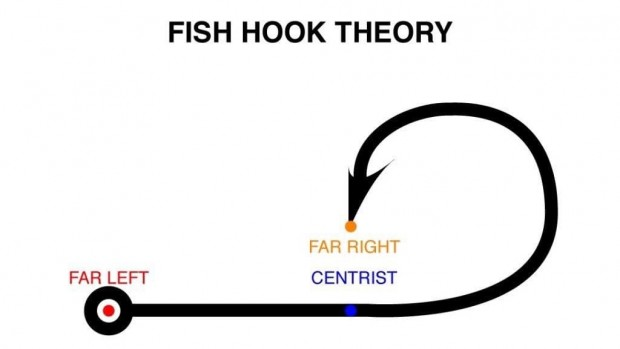
I see your horseshoe and instead propose a fishhook:
Quote:
Simon Choat, a senior lecturer in political theory at Kingston University, has criticised the horseshoe theory. In a 2017 article for The Conversation, "'Horseshoe theory' is nonsense – the far right and far left have little in common", he argues that far-left and far-right ideologies only share similarities in the vaguest sense, in that they both oppose the liberal democratic status quo, but that the two sides have very different reasons and very different aims for doing so.
Choat uses the issue of globalisation as an example; both the far-left and the far-right attack neoliberal globalisation and its "elites", but identify different elites and have conflicting reasons for attacking them. Additionally, Choat argues that although proponents of the horseshoe theory may cite historical examples of alleged collusion between fascists and communists, those on the far-left usually oppose the rise of far-right or fascist regimes in their countries. Instead, he argues that it has been centrists who have supported far-right and fascist regimes and have preferred them in power over socialists, and that the horseshoe theory is biased towards centrists, who he says use it to smear or attack the left more than the right.
He cites the example of the 2016 United States presidential election and the 2017 French presidential election, in which supporters of Bernie Sanders and Jean-Luc Mélenchon were alleged to have preferred or voted for Donald Trump and Marine Le Pen.
In this sense, he argues that the horseshoe theory is used to engage in red-baiting or reductio ad Hitlerum, which allows them to "discredit the left while disavowing their own complicity with the far right." Choat says that "it is patently absurd to compare Stalin to present-day leftists like Mélenchon or Corbyn", and concludes: "If liberals genuinely want to understand and confront the rise of the far right, then rather than smearing the left they should perhaps reflect on their own faults."
This might explain why the Democratic Party fights moderate leftists so much harder than they fight Republicans.
_________________
There's no such thing as a free market.If you're not careful, the newspapers will have you hating the people who are being oppressed, and loving the people who are doing the oppressing. —Malcolm XJust a reminder: under international law, an occupying power has no right of self-defense, and those who are occupied have the right and duty to liberate themselves by any means possible.