
Why does your God recieve special treatment?


 14 Aug 2010, 6:44 am

Okay, I apologise for the ranting nature of this post, but I'm really confused about this one.
Okay, so there is this documentary showing soon by Richard Dawkins about faith schools which me and my mother saw a trailer for on TV. My mother (who was brought up as a catholic but I think identifies herself as an agnostic) said something to the effect of "That guy is a bastard.". I asked why she felt that way and she responded that it was because she couldn't understand why he "can't leave religion alone".
She kept on trying to justify faith schools by saying stuff like "I was in a catholic school and I'm okay" and "it keeps the faith going" and "it's the parents choice what they do to their kids" and "the foundation of every religion is love so what's wrong with a faith school?". I tried to explain that just because it's not America, it doesn't mean that church and state shouldn't be seperate and tried to explain that it's not fair that these children get no say and don't get taught about other religions and will hear conflicting information in school (the RE class will talk about Adam and Eve and Biology class will talk about evolution). Or worse, they might be taught "creation science" depending on the school.
Then my mum accussed me of being militant and disrespectful towards religion, to which I said "Why should FAITH be given the same respect as EVIDENCE?". She made a point that faith doesn't need to be scrutinised because it's faith. That shocked me, so I said something to the effect of "Faith in God makes as much sense as faith in a hobgoblin that lives in your tea cup and grants wishes". Then she insisted that "NO, IT'S NOT THE SAME!! !".
TD:DR: I asked her why she thinks that a belief in a religion makes any more sense than believing in hobgoblins and the flying spaghetti monster,but she wouldn't give any answers. She just said I was being stupid and implied that I was pathetic for needing solid evidence before I could actually believe in God.
I don't get that - why does God get special treatment? If I got enough people to believe in the tea-cup dwelling Hobgoblin that grants wishes, could I get tax exempt status? Could I make schools indoctrinating children to believe in it? If the Book of Hobgoblin says "Thou Shalt not drink Coffee for that is the elixir of evil" could I pass laws to shut down Starbucks and to fine people who own their own coffee makers? What if my new, made-up religion is used as an excuse to deny people their basic human rights? Would ANYONE in their right mind take it seriously? Of course not! They would rightfully tell me to f**k off and to keep my religion to myself.
How come having faith in the judeo-christian God (for instance) is respectable and and should not be questioned, but if i believed in the Hobgoblin, I'd be called schizophrenic? I'm not calling religious people crazy nor do iI hink they're stupid - i just think it's remarkable that that there are highly intelligent people who are very skeptical and logical about everything until it comes to their religion.
AngelRho
Veteran


Joined: 4 Jan 2008
Age: 48
Gender: Male
Posts: 9,366
Location: The Landmass between N.O. and Mobile
14 Aug 2010, 11:25 am
Christians who say they don't need evidence are very strong believers, and that is an ideal that more educated persons have trouble reaching.
Here's the problem with evidence as I see it: God has "shown up" at various different times throughout human history. The problem is that God doesn't MAKE anyone believe in Him or see Him for Who He is. That's not how it works.
We as humans are capable of denying the most obvious things with evidence. I can deny that the sun exists if I wanted to. And no matter what you say, no matter how many times you point to the sun as it rises in the east, I can say "I don't care what you say it is, I don't care how many times you point up in the sky, whatever it seems to be that you think is there, it's nothing."
If it sounds foolish, it's because it IS foolish.
But when God presents Himself in the most inarguable form and in the most incontrovertible way, people STILL deny His presence. We do things like explain it away as a freak act of nature, the work of an illusionist, or denying that written accounts of eyewitnesses described actual events.
Very often we say we take things on faith because we don't have a better answer. But the truth is that everything anyone believes in requires a touch of faith. When you demand evidence for things, what makes you so sure that the evidence is even reliable or that it really shows what it purports to show? At some point, EVERYTHING is an assumption. We had an unrelated discussion some weeks ago in which someone said that the primary faith within science is that there even is an "out there" out there to observe and document. Sand makes pretty good arguments that challenge us on how we even know anything at all with any certainty. I don't necessarily agree with him, but he does make a good point.
The truth is that the most vehement deniers of Biblical Truth do not WANT evidence, but are rather more secure in their own faith that there is no God. My personal opinion (no evidence, just what I think) is that having to believe in God requires us to examine our own ways and make changes we don't really want to make. It's easier to maintain our own self-centered status quo rather than fulfill a higher purpose. The only convictions we have to answer are either our own or none at all, and it makes for an easier life with less guilt (and less work). Demanding evidence other than the evidence that we have is just a convenient way of persisting in our ways rather than being made accountable for our shortcomings.
 14 Aug 2010, 11:38 am
That's not an ideal, but rather more like a disease.
The issue is whether you can seriously live by that claim. You can continually assert it, but the issue is "can you be consistent", "are you really believing what you say or just making a point the entire time", it really seems more the latter. You can't make a consistent view of reality without the sun, as every science about life depends upon the sun from food chains to everything else. And, you know, I doubt you'll believe what you say no matter how many times you say it. Cognitive dissonance can help with small things, but not something so large, with nearly as much success.
If it is the more inarguable form and incontrovertable way, then why not have better evidence? You can't say it is literally the best evidence.
Well, you are right, they are defending a particular position. I wouldn't call this "their own faith", but I kind of see your point. However, at the same time, there is the issue of lacking evidence.
Honestly though, I don't think that your analysis of the psychology of disbelief really works. I don't think that atheists are really just trying to be self-centered. I also don't think that the belief in God adds to human guilt, in fact, from my own experience, guilt is a natural feeling, and the notion of a forgiving God can actually be used to alleviate that, such as by saying "It's ok that I fail, because God will always forgive me".
I don't think that demanding more evidence is just a matter of moral failing. Rather:
1) The assertion is somewhat insulting to all of those who do not believe.
2) The assertion doesn't seem to make much sense given that many non-believers do value moral behaviors.
3) Non-believers can be quite educated, and give good reasons for their position.
I mean, personally, I kind of find your argument from my psychology rather ridiculous, and I think others in the same boat will feel the same.
-------------------
As for the OP, the issue is that within our background of cultural knowledge, we believe in Christianity, and not the Hobgoblin. We don't usually analyze our cultural knowledge deeply, but rather trust it implicitly. How many people do you know question democracy? How many Americans question their constitution? These things don't happen, but most people haven't thought too much on the matter.
14 Aug 2010, 1:37 pm
Why does your God recieve special treatment?
Well, that's how the (non-profit, tax-exempt) religious story goes according to Moses who received the 10 Commandments in stone from the God of Judaism/the Lord of the Universe himself many years ago.
Commandment 1: I am the Lord Your God; You shall not have strange gods before Me.
---
The God of Judaism (stolen by Christianity) is the God of Gods, the Lord of Lords, and the King of Kings.
That demands respect from his earthly creatures whom He made as the Potter of Potters.
The pots (human beings) respect their Maker - the God of Judaism - the Chief Potter of all Potters.
---
http://www.beliefnet.com/
http://www.sacred-texts.com/
Religious science fiction movie
http://www.pilgrimsprogressthemovie.com/
---
... you don't tug on Superman's cape You don't spit into the wind You don't pull the mask off an 'ole Lone Ranger And you don't mess around with Jim... oops...the God of the Bible...
You Don't Mess Around With Jim by Jim Croce
---
http://en.wikipedia.org/wiki/Amazing_Grace
---
Rumor: Beatification is believed underweigh with sainthood a done deal for St. Ned
http://en.wikipedia.org/wiki/Ned_Flanders
 14 Aug 2010, 2:02 pm
Okay, so there is this documentary showing soon by Richard Dawkins about faith schools which me and my mother saw a trailer for on TV. My mother (who was brought up as a catholic but I think identifies herself as an agnostic) said something to the effect of "That guy is a bastard.". I asked why she felt that way and she responded that it was because she couldn't understand why he "can't leave religion alone".
She kept on trying to justify faith schools by saying stuff like "I was in a catholic school and I'm okay" and "it keeps the faith going" and "it's the parents choice what they do to their kids" and "the foundation of every religion is love so what's wrong with a faith school?". I tried to explain that just because it's not America, it doesn't mean that church and state shouldn't be seperate and tried to explain that it's not fair that these children get no say and don't get taught about other religions and will hear conflicting information in school (the RE class will talk about Adam and Eve and Biology class will talk about evolution). Or worse, they might be taught "creation science" depending on the school.
Then my mum accussed me of being militant and disrespectful towards religion, to which I said "Why should FAITH be given the same respect as EVIDENCE?". She made a point that faith doesn't need to be scrutinised because it's faith. That shocked me, so I said something to the effect of "Faith in God makes as much sense as faith in a hobgoblin that lives in your tea cup and grants wishes". Then she insisted that "NO, IT'S NOT THE SAME!! !".
TD:DR: I asked her why she thinks that a belief in a religion makes any more sense than believing in hobgoblins and the flying spaghetti monster,but she wouldn't give any answers. She just said I was being stupid and implied that I was pathetic for needing solid evidence before I could actually believe in God.
I don't get that - why does God get special treatment? If I got enough people to believe in the tea-cup dwelling Hobgoblin that grants wishes, could I get tax exempt status? Could I make schools indoctrinating children to believe in it? If the Book of Hobgoblin says "Thou Shalt not drink Coffee for that is the elixir of evil" could I pass laws to shut down Starbucks and to fine people who own their own coffee makers? What if my new, made-up religion is used as an excuse to deny people their basic human rights? Would ANYONE in their right mind take it seriously? Of course not! They would rightfully tell me to f**k off and to keep my religion to myself.
How come having faith in the judeo-christian God (for instance) is respectable and and should not be questioned, but if i believed in the Hobgoblin, I'd be called schizophrenic? I'm not calling religious people crazy nor do iI hink they're stupid - i just think it's remarkable that that there are highly intelligent people who are very skeptical and logical about everything until it comes to their religion.
yes, exactly. it is so interesting how so many many people are insistent that their own beliefs are correct, even though they are in opposition to their neighbour's fervent beliefs. humility may be the ideal in many religions, but i firmly argue that arrogance is a more prevalent characteristic.
_________________
on a break, so if you need assistance please contact another moderator from this list:
viewtopic.php?t=391105
 14 Aug 2010, 3:02 pm
It's because the very foundation of their world-view is skewed. They never learned about objectivity or evidence-based reasoning, or if they did it was tempered by their simultaneously being taught about religious nonsense and how "faith" is exempt from logic and reality. Don't blame them, they can't help it.
_________________
If songs were lines in a conversation, the situation would be fine.
 14 Aug 2010, 7:16 pm
Actually, people of faith do not believe that "faith" is exempt from logic and reality because the people of faith believe that the very laws of logic are conceptual realities, which is to say that they (laws of logic) exist in the mind and do not convey the idea of or relating to material things. And also people of faith believe that the laws of logic are absolute because they reflect and give evidence of the nature of the Absolute God. 
_________________
Stung by the splendor of a sudden thought. ~ Robert Browning
14 Aug 2010, 8:00 pm
Umm..... no, apparently YOU believe that the laws of logic are absolute because they reflect and give evidence of the nature of the Absolute God. Lots of theists, even Christian theists, don't think this, and have no problem solving any logical issue by saying "God is beyond logic", which in and of itself, threatens the absolute nature of logic. If logic does not necessarily hold, then how can it be considered an absolute.
In any case, it really just sounds like somebody discovered the transcendental argument.
That being said:
1) The transcendental argument, at best, proves A God, but not YOUR God exists.
2) The transcendental argument from logic, doesn't really even prove that God exists, the reason being that in order to say "logic proves God", we have to somehow prove that logic somehow requires God, a problem given that atheists tend to see no inconsistency in appealing to logic, but no God, or even a universe without God, but that has logic.
3) If God creates logic, then it also stands to reason that logic does not exist necessarily, which kind of suggests that logic could really be anything. The issue is that this is absurd and leads to absurd conclusions.
4) There are atheistic accounts of logic, such as holding that logic really is just our term for being consistent in accordance to descriptions of reality, so the reason why married bachelors do not exist, is because the descriptions are of the nature that they preclude each other, and what we call "the law of non-contradiction" really just means being consistent with that description.
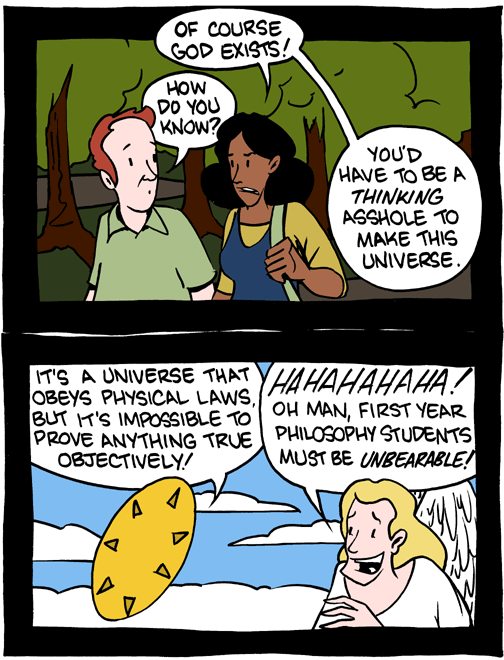
5) It is arguable, that if logic CAN be different(which seems possible if God can make logic whatever he pleases), then logic should be different due to problems emerging from how logic currently works. These can be introduced through comics actually kind of joking about the matter. If logic is contingent, rather than necessary and thus can actually be different, and if God can create logic, then we should perhaps expect a logic that doesn't have the problems we see in logic:

 14 Aug 2010, 8:06 pm
Jackpot! you win!
http://en.wikipedia.org/wiki/Blake%27s_ ... ke.27s_Law
_________________
.
Bethie
Veteran

Joined: 26 Jul 2010
Age: 38
Gender: Female
Posts: 2,817
Location: My World, Highview, Louisville, Kentucky, USA, Earth, The Milky Way, Local Group, Local Supercluster
15 Aug 2010, 5:51 am
I lol'ed...HARD.
"You can't reason someone out of a belief they weren't reasoned into."
Sounds like you held your own and raised some very good points. At least you probably gave her food for thought.

_________________
For there is another kind of violence, slower but just as deadly, destructive as the shot or the bomb in the night. This is the violence of institutions; indifference and inaction and slow decay.
 15 Aug 2010, 9:41 am
response: think of about Islam. Where is the love?
ruveyn
I don't see any love in Islam. Yet the god of the Jews is a harsh bastard who kills people by the million and I don't see that the god of the Christians is much better.
Blindspot149
Veteran

Joined: 7 Oct 2009
Gender: Male
Posts: 2,516
Location: Aspergers Quadrant, INTJ, AQ 45/50
15 Aug 2010, 12:53 pm
Religion is the opium of the masses and keeps billions of people in ignorance and poverty.
It is a man made political tool, that is still used as a bludgeon in many 'modern' countries today.
Try getting elected President of the US without appearing on TV at least once, as a pious churchgoer

Try inviting a Muslim friend to church in many Muslim countries and see what happens

Religion of course should not be confused with God who if He/She/IT exists at all, exists independently of religion and needs no legal protection from 'blasphemy' or any other restriction that Man chooses to create in the name of religion.
_________________
Now then, tell me. What did Miggs say to you? Multiple Miggs in the next cell. He hissed at you. What did he say?
Last edited by Blindspot149 on 15 Aug 2010, 10:44 pm, edited 1 time in total.
15 Aug 2010, 8:03 pm
Umm..... no, apparently YOU believe that the laws of logic are absolute because they reflect and give evidence of the nature of the Absolute God. Lots of theists, even Christian theists, don't think this, and have no problem solving any logical issue by saying "God is beyond logic", which in and of itself, threatens the absolute nature of logic. If logic does not necessarily hold, then how can it be considered an absolute.
In any case, it really just sounds like somebody discovered the transcendental argument.
That being said:
1) The transcendental argument, at best, proves A God, but not YOUR God exists.
I actually find it to be very good proof for the existence of the God of the Bible.
I believe that the existence of logic proves God's existence (and that the existence of God proves logic's existence) because if God did not exist, then logic would be relative; and if logic were relative, then arguments could never be determined, since all arguments would simply all be relative. Therefore, in order for science to spot errors and to logically determine things, logical absolutes must exist.
Logic is not a created thing, rather it is an attribute of God's existence as it pertains to His nature, His thought processes as it were.
The law of logic cannot be "consistent in accordance to descriptions of reality" because each person describes reality in his or her own peculiar - and often contradictory - way. Sometimes the mind gets a little discombobulated with and by the universe. I believe, though, that since logic is part of God's very nature, then logic is necessarily existent because it is based on God's existence. In short, logic necessarily must exist because God exists.
I don't believe that the law of logic can be "different" from itself, or manifest itself in "different" ways, because that would indicate that logic is a just a subject that someone votes on.
_________________
Stung by the splendor of a sudden thought. ~ Robert Browning
15 Aug 2010, 8:57 pm
Ok, the issue is that in order to be proof, there has to be evidence that both the God of the Bible is seen in the Bible as establishing logic, and that this proof only works for the God of the Bible and not other forms of deity, even hypothetical deity. The issue with the former is that you would have to show that the earliest Jews or earliest Christians actually believed that God established logic, and preferably even that the nature of their religion is such that it promoted Jewish high philosophical inquiry, which would be an expression of enjoying and valuing logic. (that latter being questionable given that philosophical inquiry as we understand it owes everything to the Greeks and very little to Judaism)
Who said that logic has to be relative if God exists? I don't know of an atheist, or anybody but a person who holds to your apologetic who would assert something like this, and you certainly haven't given me or anybody else reason to believe it.
Well, ok, but you've just pushed the whole issue a step back. Either logic is logic by virtue of the characteristics specified, in which case, there is no reason why it needs God, as it should be necessary for existence of any sort period, or logic is logic because God expresses it, then we end up having this problem of arbitrariness.
Well, when a person describes reality in a contradictory way, we can tell this because the descriptions of reality they give say two or more things that based upon their definition are incompatible with each other. The issue here is that there is no external law to refer back to, but rather logic itself just reduces to the meanings expressed in the definitions of terms. The point I am getting at doesn't rely upon subjective opinion, but rather the nature of expressed definitions, and it is basically to say that "there is nothing to explain about logic at all".
How about this: what would make it such that bachelors(which can be defined as unmarried men) can be married if God does not exist? Or that I can both have or not have a car? I just can't see how such instances are possible at all, but I also don't see how this impossibility is contingent upon God.
Well, if logic can't be different than what it is, then why do we have to appeal to God to make it exist? It seems to me that if logic is necessarily the way it is, then it can also exist by necessity, rather than being contingent upon God or the nature of God.


