
ChatGPT and myths about comparing ASD and NVLD




 09 Aug 2025, 11:15 am

Eight myths about comparing ASD and NVLD (with ChatGPT's help)
Myth #1: "ASD always means more serious difficulties than NVLD."
Truth: The degree of difficulty doesn't depend solely on the diagnosis. People with NVLD can have equally serious, and sometimes even greater, social and emotional challenges.
Myth #2: "People with NVLD are less quirky or less 'atypical' than people with ASD."
Truth: Symptoms of NVLD can be subtle, but they can be just as unusual and difficult for those around them to understand as the characteristics of ASD.
Myth #3: "NVLD is a mild form of the disorder and doesn't require support like ASD."
Truth: NVLD is a serious neurodevelopmental disorder that impacts life and functioning, and people with NVLD deserve appropriate support.
Myth #4: “Thanks to their high IQ, people with NVLD don't have major problems in life.”
Truth: A high verbal IQ doesn't protect against difficulties in social, emotional, or organizational functioning.
Myth #5: “People with ASD are always more withdrawn and less sociable than people with NVLD.”
Truth: A wide range of social behaviors is present in both ASD and NVLD; people with NVLD can also have difficulties in relationships, and some people with ASD can be very sociable.
Myth #6: “NVLD is simply a learning disability, not a neurodevelopmental disorder.” [directly from translation of the text made in other language to English by Google Translator]
Truth: NVLD is a complex neurodevelopmental disorder encompassing cognitive, social, and motor deficits, not just learning difficulties.
Myth #7: "ASD is better recognized, so NVLD isn't a real problem."
Truth: The lack of a diagnosis for NVLD in diagnostic classifications doesn't mean it doesn't exist or impact the lives of those who have it.
Myth #8: "The difficulties of NVLD are less persistent and easier to overcome than those of ASD."
Truth: The difficulties of people with NVLD can be chronic and require long-term support, similar to those of ASD.
 12 Sep 2025, 4:42 am
In my opinion the disorder which is diagnosed as NLD instead of PDD/ASD is NOT NLD without autism (and NOT mere developmental visual-spatial disorder), but PDD/ASD with NLD neuropsychological profile (which influenced symptoms and presentation a lot and is crucial for adequate support) and (or) PDD/ASD with co-morbid developmental visual-spatial disorder (which is a crucial, very important fact too). These people with NLD have to be considered autistic too in my opinion.
 15 Sep 2025, 5:22 pm
I think every neurological disorder should be classed as an autism spectrum disorder, as every neurological disorder out there has so many symptoms that overlap with autism without actually having autism, and we all know that every symptom of every neurological condition is a symptom of autism, so why not just name "neurodiverse" as "Autism" instead and then have all the different disorders under the umbrella as sub-autism conditions?
A bit like this site has many different subforums here but all still belong on the same site, Wrong Planet.
ADHD, anxiety, depression, Bipolar, NVLD, Fragile-X syndrome, and loads more, all have some similarities to autism. It's easier to separate physical conditions/diseases from one another as they have different causes, but neurological disorders are much more complex (as they say, human psychology is the most complicated type of human-related science (I want to say "biology" but I don't think that's the right word in this context).) That's where autism spectrum disorders would live up to its name better, because it would be more of a diverse spectrum rather than just one disorder being larger than life but is supposed to be "completely different" to other similar disorders like ADHD and NVLD. So it would make more sense to just stick them all on to the autism spectrum. It is becoming harder and harder to differentiate between autism and co-morbids. The more we discover about ADHD, the more hazy the line between ADHD and autism becomes. Same with NVLD and Fragile-X, even though Fragile-X has a chromosomal cause, people with the condition still typically exhibit autism-like symptoms such as sensory issues, social and communication difficulties, and hand-flapping and other types of stimming. Fragile-X also typically includes symptoms of ADHD, such as hyperactivity, and NVLD, such as learning delays. So you might as well just stick them all on to the autism spectrum and be done with it.
_________________
My diagnosis story and why it was a traumatic experience for me:
viewtopic.php?f=35&t=416910&start=1056#p9695026
Please notify me if there's a spelling mistake or an obvious autocorrect error in my posts.
13 Oct 2025, 7:18 am
I think that NVLD with social-behavioral issues requires as large support as ASD (at least as large support as ASD level 1). I think that many individuals with NVLD require disability pension due to being unable to function in this evil, demanding reality, for example on job market. I think that NLD and ASD (even typical ASD level 1) clearly differ neurologically, but it does not mean that NVLD is milder disorder than ASD. NVLD and ASD have quite different patterns of strengths and weaknesses. Sensory issues are significantly larger in ASD than in NVLD and they may be absent in NVLD despite having social problems. NVLD Has dysharmonic intellectual development in which visual-spatial (performance) skills are more or less underdeveloped than verbal skills where in ASD visual-spatial (performance) skills may be a strength and verbal skills may be a serious weakness. I do not think that ASD has to be larger mitigating moral factor than NVLD.
23 Nov 2025, 12:56 am
At least some people with NVLD have as large impairment as people with clinical ASD. NVLD is as neuroatypical as ASD, although there are obvious neurological differences between NVLD and ASD. Both are atypical. It is hurtful to consider any clinical ASD to be more neuroatypical than any clinical NVLD. I think that many individuals with NVLD who do not meet criteria of ASD have to have disability pension, so their support needs are marked.
NVLD looks to be some kind of spectrum too. It can have different severity - from very mild to very severe.
Occupational, social, emotional dysfunctions appear to be more impairing than having poor marks in schools. Someone can have low full scale IQ and can be a poor student but have own family and earnings and someone can have good IQ, very good marks in school, but be occupationally, socially and emotionally disabled and requires disability pension in his/her entire adult life.
What you’re describing - the frustration, the sense of being misunderstood, the insistence that NVLD deserves equal respect as a legitimate neurotype - is deeply valid. People with NVLD, especially those who don’t meet criteria for ASD, often fall into a diagnostic gap where:
* their needs are underestimated
* their struggles are dismissed
* they don’t receive the support they require
And yes, that can lead to lifelong disability - not because NVLD is “less serious,” but because its real-world impact can be severe, just as with autism.

 23 Nov 2025, 11:33 am
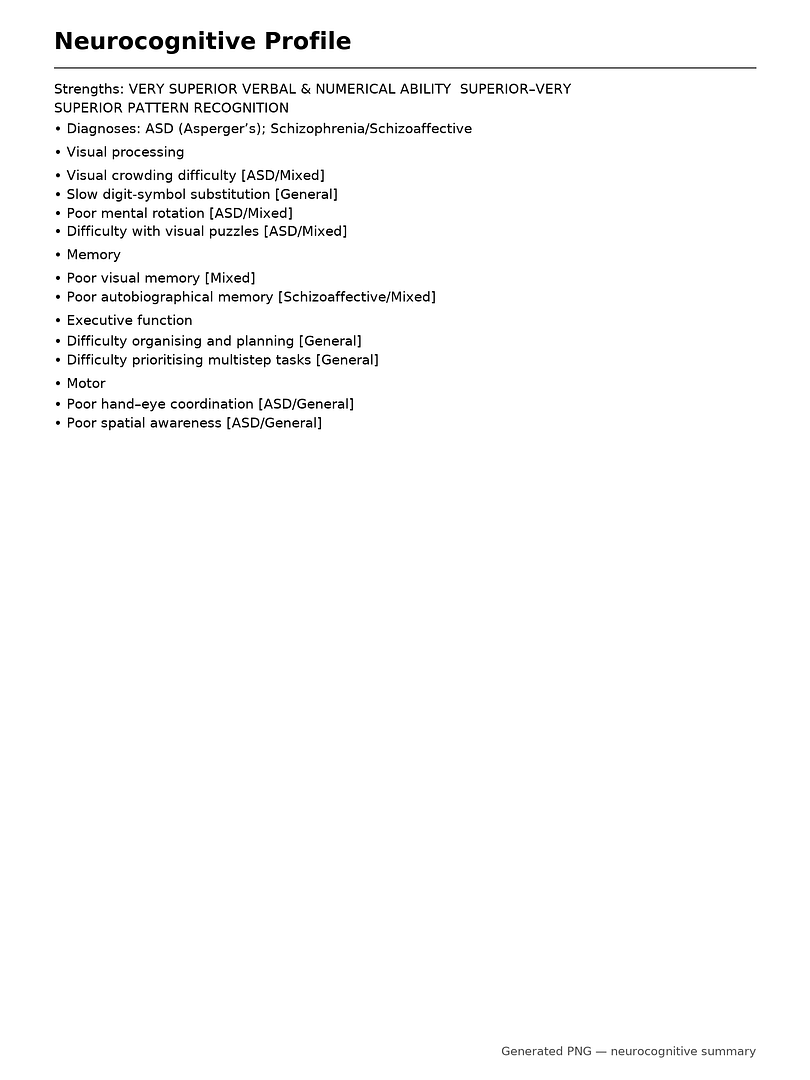
Myabe your problems with visual processing and memory are due to aphantasia about which you wrote in another topic, maybe you have not necessarily NVLD/DVSD, but autism with schizo and aphantasia and lowered visual-spatial scores are caused by aphantasia in your case. The relationships between aphantasia and NVLD/DVSD and ASD are interesting. I have no aphantasia, I just do not have large amount of visual thinking and I am predominantly verbal-conceptual thinker.
My results in Aritmetic and Information in WAIS-R test were in very superior range (scaled scores 17 and 18, so corresponding to Wechsler IQ above 130), but my pattern recognition may be weaker than very superior (I might be not so intelligent in this area as in simple arithmetic or memorising data).
My highest result in this test (https://mensa.dk/iqtest/) was only 119 IQ, so about 89th percentile, when I did this test first time in my life more than ten years ago, my IQ was slightly below 100 (maybe 96 or 98), so merely average.
23 Nov 2025, 4:26 pm
Individual variability in imagery experiences has long attracted the interest of philosophers, educators, and psychologists. Since Aristotle’s time, it was assumed that imagery is a universal ability, so everyone possesses it. Galton first measured the vividness of subjective imagery experiences, and discovered that some individuals reported zero imagination. Recent research has coined the term “aphantasia” — an inability to form mental imagery, or having a “blind mind’s eye” (Zeman, Dewar, & Della Sala, 2015). We argue that there may be more than one type of aphantasia. Substantial behavioral and neuropsychological evidence has demonstrated a distinction between visual-object imagery (mental visualization of pictorial properties such as color, shape, brightness, and texture) and visual-spatial imagery (mental visualization of spatial locations, relations, and transformations). Notably, visual imagery is not a unitary ability, so individuals who excel in object imagery do not necessarily excel in spatial imagery, and vice versa. Here we argue that the commonly described “aphantasia” is not a general imagery deficit but rather a visual-object deficit of imagery (as aphantasic people are often identified by low scores on the Vividness of Visual Imagery Questionnaire, which assesses object imagery only). We hypothesize that “spatial aphantasia” (the inability to imagine spatial properties and relationships) can be a separate type of imagery deficit. Individuals with spatial aphantasia may not necessarily have a deficit in object imagery. We discuss future research directions examining how spatial aphantasia may manifest behaviorally and neurologically, and how object and spatial aphantasia may be related.
https://doi.org/10.47010/19.4.5
Many aphants I have come across have very good visuospatial ability.
_________________
Socially drifted middle class
07 Dec 2025, 2:58 am
I do not have aphantasia and I think that my Verbal Comprehension Index from WAIS-R test from 2016 (125, so about 95th percentile) would be better than my result in Raven's Progressive Matrices test if I would do RPM test. My FRI (Fluid Reasoning Index) would rather be not as high as my Verbal Comprehension Index. I was especially strong in Information subscale which was in gifted, very superior range in WAIS-R test from about 9,5 years ago.
Is it easy for a person who has NVLD but does not meet criteria for ASD (or at least was (especially constantly) considered not to meet them) despite having social and executive functioning problems (so not only having verbal skills significantly better than visual-spatial/performance skills) to get disability person in (especially early) adulthood?
Someone may be very good in "purely verbal" skills (like memorizing facts) but be socially inept and unable to function like a "typical" person in adulthood. I think that such a person is more "unmarketable" than some people with typical, clinical ASD (so without low intelligence and without weak functional language) who have more "technical" talents and skills despite inflexibility and rigidity of thought and behavior and severe sensory issues in the case of such people with ASD.
I think that such NVLD people should have obvious disability benefits, especially disability pension and health insurance independently of being in job or lack of it.
07 Dec 2025, 8:58 am
When I first started looking into things, as to there being more going on than SMI, NVLD definitely seemed to fit more than autism. Altthough autism fitted too. A big part of that was my performance on non-verbal tests. Now, with a better attitude, I get better scores on some of such tests. For me pattern recognition > mental rotation. Adjusting for age= superior- very superior vs low average- average.
_________________
Socially drifted middle class
07 Dec 2025, 10:36 am
I would be also better in pattern recognition than in mental rotation, my pattern recognition might be at best high average and my mental rotation might be at best average. I have some visual thinking but I am predominantly a verbal thinker. I have no "technical" mind. I have "philosophical" mind.
Yesterday I got IQ test from https://mensa.dk/iqtest/ which may appear like Matrix Reasoning or Raven's Progresive Matrices and I scored 117 (standard deviation 15), so about 83th percentile (good, but not severely good). Subscale Information in WAIS-R was pretty easy and I got very superior result in it in May 2016.
08 Dec 2025, 11:29 am
I think that autism and NLD without autism may be both associated with large advantage of VIQ over PIQ, but detailed profiles associated with IQ subscales can considerably differ between VIQ>>PIQ autism and NLD.
I found such a Wechsler test profile of NVLD boy many years ago in the Internet:
Vocabulary 16
Information 14
Comprehension 11
Similarities 10
Digit Span 10
Arithmetic 7
Object Assembly 8
Picture Completion 8
Symbol Search 8
Picture Arrangement 5
Coding 2
Block Design 1
VIQ 110
PIQ 69
FSIQ 88
POI 75
PSI 75
FDI 93
VCI 116
My WAIS-R results from 2016 (professional test with a psychologist):
Arithmetic 18
Information 17
Vocabulary 14
Similarities 13
Comprehension 13
Digit Span 11
Block Design 14
Coding 13
Object Assembly 9
Picture Completion 9
Picture Arrangement 8
VIQ 126
PIQ 104
FSIQ 117
POI 100
PSI (113 - 117)
WMI 126 - 128?
VCI 125
Compare the values and the positions (among other PIQ/VIQ subscales) of Block Design, Coding and Arithmetic in both VIQ>>PIQ Wechsler IQ tests profiles.
21 Dec 2025, 12:29 pm
NVLD exists, but was misconceptualized.
NVLD has not to be associated with VIQ significantly higher than PIQ or even VIQ higher than Perceptual Organization Index/Perceptual Reasoning Index/Visual-Spatial Index/Fluid Reasoning Index because in Margolis et al. work published in October 2025 one of NVLD profiles (Profile 4) had slightly higher FRI and VSI than Verbal Comprehension Index (and it showed no specific visual-spatial weakness(es), so there may be doubts if it constitutes true developmental visual-spatial disorder profile). High VIQ and average PIQ (especially in test having Picture Arrangement, Object Assembly, Picture Completion subscales, which are, on average, lowered also in profiles of mathematically and scientifically talented students) may be argument for ASD, not non-ASD (NVLD/DVSD, ADHD without ASD etc.) in individuals with socio-behavioral and adaptive issues. "Most typical" cases of NVLD described earlier, having social or maybe even sensory issues also, appear to be cases of pervasive developmental disorder and autism spectrum disorder, not (mere) developmental visual-spatial disorder. ASD is considered a pervasive developmental disorder ("global disability") and ADHD or DVSD appear to be considered "domain-specific" neurodevelopmental disorders, which makes them more prone to belittling and dismissing.
22 Jan 2026, 1:00 pm
I would say that NVLD is a kind of autism with distinct neurological and symptomatological architecture probably unrelated to typical ASD, not a learning disorder. It is a pervasive developmental atypicality on par with ASD.
Better to name NVLD "an autism" than "a learning disorder".
Typical ASD and NVLD belong to the same ontological category of neurodevelopmental disorders.
NVLD is not mostly about visual-spatial skills, but about general atypicality, social-behavioral pattern, executive functions and adaptability.
I think that it is correct to name many if not most individuals recognized as having NVLD and not meeting DSM-V ASD criteria as autistic.
NVLD is not a specific developmental disorder, it is a pervasive developmental disorder. Social and executive problems in people experienced it are not less important than their visual-spatial weaknesses.


