
study shows climate deniers know facts but just dont care


Tollorin
Veteran


Joined: 14 Jun 2009
Age: 44
Gender: Male
Posts: 3,178
Location: Sherbrooke, Québec, Canada
 14 Jul 2014, 10:35 pm

That's just ridiculous, neutrino interact very weakly with matter and even the most sensible detectors ever made by humanity can't detect cosmic neutrino background. If neutrino somehow noticably warmed the earth, it would be mostly in the inside of the planet (The average window block a larger proportion of visible light that the the proportion of neutrino blocked by our entire planet, propably by many order of magnitude, seriously. So it mean that most whatever warming neutrino do to our planet, it's in the inside, below the atmosphere and the earth crust.), meaning that the only noticeable effect would be a rise of volcanism, which mean global cooling. Unless of course you count the CO2, which would mean global warming in the long term. But then, you would need to explain how, somehow, the CO2 of a volcano would count more that the CO2 emited by oil and coal. (Which is greater in quantity that the CO2 emited today by volcano by the way.)
Add that the cosmic neutrino background radiation would most likely (I think) be constant (Well, it must slowly diminish with time, but in the scale of millions, even billions of years. So for much pratical purpose, we must consider it to have remained constant through humanity history.)
And you say working in a field related to science... Even me I know all those things, even though I'm not a scientist. (Though I must admit to know more about science that the average person.)
(A little graph, by the way. And this time you can't say it's because a lack of standardisation, as the base unit used is defined by the speed of light.)

 15 Jul 2014, 1:32 am
Given that you were confused about the difference between a unit and a measurement, it might be time to broaden your definition of relevance. Either way, it was't addressed to you.
I see only one claim of mine that you could be referring to:
That was a reference to weather stations, not the Anderson et al. study.
But regarding your "refutation":
First of all, NOAA-sponsored climatology course material lists uncertainties for instruments alone at +/- 0.5 C - much higher than my suggestion of +/- 0.2 C for the entire system:
http://www.cgd.ucar.edu/cas/tn404/text/tn404_6.html
The GISTEMP and HADCRUT4 uncertainty values that you referred to assume a normal distribution, which isn't reliable when estimating measurement error. Instrument calibration error and problems with placement and heat-gain can be systematic. (That's discussed briefly in the link.) Even the fluorescent lights in my lab will raise the surface temperatures of samples by more than 0.2 C. I didn't feel the need to cite sources because a claim of +/- 0.008 C in a ratty little weather shack is surreal.
Second, from the Anderson et al. paper: "We hypothesize that the confounding influences cancel in the global average, and test by comparing the full series with a subset that excludes tropical oxygen isotope series."
That would only spot regional variations, and not all of them. Most of the series are located on land or close to shore, for example. The O-16 to O-18 ratio is also influenced by water salinity and a few other things: http://en.wikipedia.org/wiki/%CE%9418O
Also: "We used the age determinations [for proxies] as originally reported. The reported age uncertainty varies, and is lowest in the layer-counted proxies and largest for the proxies that relied on radiocarbon dating." That wouldn't change the trend, but could influence observations like this:
"Smaller-scale aspects of the GST including two warming trends and a warm interval during the 1940s are also observed in the PI."
Last edited by NobodyKnows on 15 Jul 2014, 2:59 am, edited 6 times in total.
15 Jul 2014, 2:33 am
That's just ridiculous, neutrino interact very weakly with matter and even the most sensible detectors ever made by humanity can't detect cosmic neutrino background.
I'm re-writing this because I found the article where I'd originally seen the CNB density figures:
http://www.astro.ucla.edu/~wright/neutrinos.html
I mentioned the CNB and dark matter to argue that it's not safe to treat the solar system as a closed system, as a popular AGW site did here:
http://www.skepticalscience.com/global- ... system.htm
From their article: "If [heating] is happening throughout the solar system, clearly it must be the sun causing the rise in temperatures."
That's a fair starting assumption, but I'm not ready to call it a day. We're still missing 95% of the mass-energy in the universe, and I'm not comfortable telling it what it can can can't do when I can't even describe it.
It was a Harvard physicist who suggested recently that the solar system's passage through regions of higher (and lower) dark matter density could shift the orbits of comets (and presumably other objects) enough to change the rate at which they strike Earth:
http://www.nature.com/news/did-dark-mat ... rs-1.14839
I don't remember anyone deriding her or calling the idea "ridiculous," although some thought it unlikely.
The UCLA page (top link) estimated the CNB as having "about 56 electron neutrinos, 56 electron anti-neutrinos, 56 muon neutrinos, etc., per cubic centimeter, for a total of 337 neutrinos per cubic centimeter in the Universe," and that the photons of the cosmic microwave background are "slightly more numerous with 411 photons/cc." Also, "Because the number of neutrinos in the Universe is so large, even a very small neutrino mass can have drastic consequences for cosmology."
Do you know that? I haven't found the absorption rates yet. I'm still looking through Fermilab/NOvA papers to see if they published one. Detection is a lot harder because it has to produce a recognizable signal. The best material for interacting with them would be a dense metal, but you would never know that it had happened. Neutrino-nucleon interactions in nature would be hard to distinguish from ambient heat:
http://www.nevis.columbia.edu/ccfr/physics.html
Given a universal average density of 337 CNB neutrinos per cc, and a speed close to that of light, about 10 trillion CNB neutrinos will pass through every cubic centimeter of the universe each second. There are other neutrino sources, and neutrinos they make up a minority of dark matter. The density of all forms of dark matter should be higher in areas with a high density of visible matter, since both have mass and respond to gravity.
As for energy: Photons at the high end of the visible spectrum have an energy of about 3.3 eV. IR photons have energies of less than 1.8 eV. UV goes all the way up to 124 eV. I don't know the average energy within the CNB, but neutrinos (probably from other sources) can have as much as one peta-electron volt:
http://news.psu.edu/story/277206/2013/0 ... s-detected
That's probably true of the CNB, but not necessarily true of dark matter. (See the Nature article.)
The core, mantle and crust are thermally coupled. They former two also have a higher thermal conductivity than surface rock, and also quite a bit of convection. I would expect heating of the core to influence crust temperature slightly.
I suggested neutrinos as a thought experiment. There are also factors like the density of dust in space that the solar system passes through.
Last edited by NobodyKnows on 16 Jul 2014, 10:44 pm, edited 7 times in total.
 15 Jul 2014, 9:11 am
http://www.cgd.ucar.edu/cas/tn404/text/tn404_6.html
Once again, you are confusing the uncertainty of a single point observation with the uncertainty of a trend (or an average, for that matter).
Here is an excellent illustration from the HADCRUT3 data on why the two should not be conflated:
Source (see page 6):
Brohan, P., Kennedy, J. J., Harris, I., Tett, S. F., & Jones, P. D. (2006). Uncertainty estimates in regional and global observed temperature changes: A new data set from 1850. Journal of Geophysical Research: Atmospheres (1984?2012), 111(D12).
http://www.metoffice.gov.uk/hadobs/hadc ... cepted.pdf
Furthermore, the above review of the error margins in the HADCRUT3 data was extended to the HADCRUT4 data in Morice et. al (2012):
Source:
Morice, C. P., Kennedy, J. J., Rayner, N. A., & Jones, P. D. (2012). Quantifying uncertainties in global and regional temperature change using an ensemble of observational estimates: The HadCRUT4 data set. Journal of Geophysical Research: Atmospheres (1984?2012), 117(D8).
http://onlinelibrary.wiley.com/doi/10.1 ... 3-bib-0004
Here, when including known - and previously non-included sources of uncertainty and bias (see section 3) the global warming trend is still the same. Even when correcting for - and combining - (1) bias uncertainty, (2) measurement and sampling uncertainty and (3) coverage uncertainty, there is still a clear and consistent global warming trend. See table 6 under figure 71 in the study.
First of all: Due to the central limit theorem, the standard error of the estimate for the population mean approaches a normal distribution as the sample size approaches 30 or more, even if the population distribution deviates massively from a normal distribution. Given the very large sample sizes from the land and sea instrumental temperature record, deviations from a normal distribution do not pose a challenge to estimating average global temperature.
Second of all: All the studies I have cited so far have included corrections for known sources of bias.
Anderson et al. 2013 (the 1st study) - See page 3:
http://www.environ.sc.edu/sites/default ... on2013.pdf
Kennedy et. al 2011 (the 2nd study) - See page 6-11:
http://www.metoffice.gov.uk/hadobs/hads ... inline.pdf
Brohan et. al 2006 (the 3rd study) - See page 9-11:
http://www.metoffice.gov.uk/hadobs/hadc ... cepted.pdf
Morice et. al 2012 (the 4th study) - See section 3.1 and 3.2:
http://onlinelibrary.wiley.com/doi/10.1 ... 17187/full
Third of all: Simply postulating the existence of bias without providing evidence to its existence isn't a valid scientific argument.
As demonstrated above, multiple sources of uncertainty and bias have already been identified by climate scientists long ago, and both the proxy and instrumental temperature records already take these into account. Even then, the global warming trend is unambiguous and consistent across multiple independent temperature records.
Your claims about uncertainty and bias in the temperature record are thus not supported by the empirical evidence.
sonofghandi
Veteran

Joined: 17 Apr 2007
Age: 47
Gender: Male
Posts: 3,540
Location: Cleveland, OH (and not the nice part)
16 Jul 2014, 11:44 am
I am not going to go into the massive mathematical physics, but let me just say right now that neutrinos are not having an effect on the Earth's temperature any more than someone dropping a dozen lit matches into the ocean would affect the ocean's temperature.
_________________
"The surest way to corrupt a youth is to instruct him to hold in higher esteem those who think alike than those who think differently" -Nietzsche
Sweetleaf
Veteran

Joined: 6 Jan 2011
Age: 36
Gender: Female
Posts: 35,278
Location: Somewhere in Colorado
16 Jul 2014, 12:01 pm
As I say, I'll defend "saving the trees" when the abolish paperback college textbooks.

Because trees are obviously the most renewable resource paper can be made from

See its the wasteful attitude of people so opposed to making changes to do less damage to the environment and have less negative impact on the ecosystems and what not that bothers me. Sure there are people who get all hung up on environmentalism to the point they actually think all environment issues are caused by humans and it will 'go away' if we become more sustainable and less wasteful when it comes to resources...which is also ridiculous. There would be climate change even if humans made it so they aren't contributing to it in any way, there would still be natural disasters, still droughts and famines and what not and there are diseases and insects that will kill off large areas of plants thus destroying ecosystems.
But yeah trees are needed for air quality, using them all up for paper would not be a good thing given how long it takes them to grow....now it would take a very long time for humans to use up all the trees, but if we continue relying soley on those for most paper eventually there is a chance of using most of them and cutting down most of the forest ecosystems....so why continue on that path when there are other more renewable resources paper can be made from?
Why continue using a non-renewable resource, when there are viable alternatives? even if you're not some tree-hugging hippie or whatever.
_________________
Tis the time to melt the Ice.
17 Jul 2014, 2:54 pm
http://www.cgd.ucar.edu/cas/tn404/text/tn404_6.html
Once again, you are confusing the uncertainty of a single point observation with the uncertainty of a trend (or an average, for that matter).
Your statement above would make sense if you were assuming the following:
1: If instruments have systematic errors, those errors will be constant over their range, and stable over time, so the trend is still provable to a much lower uncertainty.
2: Because there are so many different stations, they will surely be off in different directions, so the global average will be provable to a much lower uncertainty.
Neither of those statements is true.
An instrument can have an offset scale, a non-linear scale, incorrect magnitude, random noise or drift. All of those can be directional. All of them can be caused by manufacture and design, which are globally consistent (especially in instruments).
Non-linearity can make a stable trend appear to accellerate.
Magnification error can make it appear larger than it is.
Drift can can fabricate a trend entirely. (That's where those "irrelevant" calibration and traceability procedures come in handy.)
If we use the NCAR value (+/- 0.5 C), the entire warming trend over the last century (0.6-0.7 C) is within the margin of error. The "random error" of 0.2 C in the HADCRUT3 paper refers to repeatability, not uncertainty. (Their math wouldn't work otherwise, and Folland et al. doesn't consider instrument design.) Uncertainty is a much stricter standard.
Manufacturing errors vary by the type of instrument: Mass-produced liquid-in-glass thermometers are unlikely to be ruled individually (it's expensive and slow), so the scale linearity would depend on how consistent the cross-sectional area of the channel is. Scale magnitude would depend on matching the volume of fluid, the combined volume of the reservoir and channel up to the high mark, and the volume of the reservoir up to the low mark. The required shape is hard to make (especially in glass), and as you can see below, they accept a fair amount of irregularity outside of the ruled section of the channel:
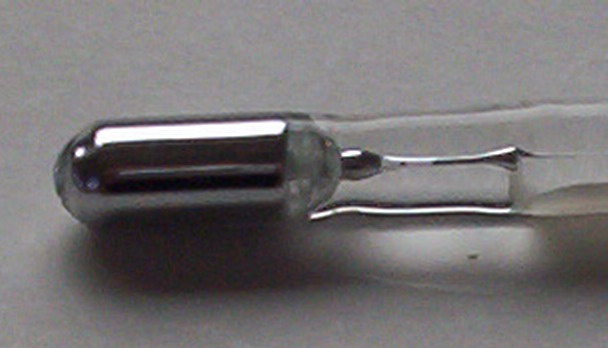
You can't assume that errors are non-directional, because manufacturing processes often have a directional bias. For example, a mold core used to make a long inner diameter is more likely to wear on the end that protrudes farthest into the workpiece.
I've never used thermocouples for anything important, but contact-oxidation might cause drift.
Source:
Morice, C. P., Kennedy, J. J., Rayner, N. A., & Jones, P. D. (2012). Quantifying uncertainties in global and regional temperature change using an ensemble of observational estimates: The HadCRUT4 data set. Journal of Geophysical Research: Atmospheres (1984?2012), 117(D8).
http://onlinelibrary.wiley.com/doi/10.1 ... 3-bib-0004
Here, when including known - and previously non-included sources of uncertainty and bias (see section 3) the global warming trend is still the same. Even when correcting for - and combining - (1) bias uncertainty, (2) measurement and sampling uncertainty and (3) coverage uncertainty, there is still a clear and consistent global warming trend. See table 6 under figure 71 in the study.
That's encouraging (in an apocalyptic sort of way).
First of all: Due to the central limit theorem, the standard error of the estimate for the population mean approaches a normal distribution as the sample size approaches 30 or more, even if the population distribution deviates massively from a normal distribution. Given the very large sample sizes from the land and sea instrumental temperature record, deviations from a normal distribution do not pose a challenge to estimating average global temperature.
N/A, since the instrument errors aren't known to be independent of each-other. (See manufacturing considerations above.)
Anderson et al. 2013 (the 1st study) - See page 3:
http://www.environ.sc.edu/sites/default ... on2013.pdf
I like the concept of using O-16/O-18 ratios, but that may be because I don't know the sources of error as well.
http://www.metoffice.gov.uk/hadobs/hads ... inline.pdf[
^ This is actually pretty good.
http://www.metoffice.gov.uk/hadobs/hadc ... cepted.pdf
^ So is this.
http://onlinelibrary.wiley.com/doi/10.1 ... 17187/full
^ This is your first mention of this one.
The technical definition of uncertainty is surprisingly close to the dictionary one. If you can't prove that a type of error is absent, an estimate of its magnitude has to be added to the uncertainty column until you can.
By "long ago," you mean post-2005. This debate has been going on for 30 years.
Last edited by NobodyKnows on 17 Jul 2014, 7:24 pm, edited 1 time in total.
17 Jul 2014, 4:14 pm
You're back to the intelligent design argument: "Prove me wrong." It's your sources' responsibility prove that they're right, since they're making a positive claim. I've mentioned types of instrument error that would need to be ruled out before you can support it. None of your sources has taken a serious look at instrument error beyond the faith-based averaging that you're so fond of. Saying that bringing it up "isn't a valid scientific argument" is complete bull, and you know that. When a scientist says "I found _____!", other scientists go over the data looking for holes in the evidence. Yours has huge ones. Your sources also waited 20 years to even consider measurement error. That's crazy.
When you use an instrument for something that matters, you're expected to know what its error breakdown is. Even as a junior tech, I was warned that the stages on older measuring machines will hydroplane by ~0.0001-0.0003". I was shown how to test for the error. I was shown how sensitive a bore-gauge is to the heat of my hand.
When I have to use a thermocouple, it's checked against a 2' laboratory-certified mercury thermometer before and after the measurement (to check for drift). The tests are done submerged to minimize variations. A CMM's datum plane is re-acquired before each measurement because its air-bearings are sensitive to operating pressure.
Not knowing is not professional.
You accused me of merely postulating biases, but if your sources had done their homework, I wouldn't be able to postulate anything that wasn't already covered in their uncertainty assessment.
Last edited by NobodyKnows on 19 Jul 2014, 1:07 am, edited 3 times in total.
 17 Jul 2014, 5:36 pm
You're back to the intelligent design argument: "Prove me wrong." It's your sources' responsibility prove that they're right, since they're making a positive claim.
Not quite.
Viper has posted considerable evidence that supports his claim. Now you wish to disprove his claim. The emphasis is not on you to produce evidence that your claim is better than his (not, necessarily, that he is wrong).
I think your last post is thoroughly sensible, comfortably the best piece of scientific heresy I have read, but then I haven't read the literature Viper cites to know if it addresses your concerns.
I do know, however, that like evolution, AGW is "too beautiful" to not be true. We have a mechanism and a correlation. We also have an explanation for loads of other phenomena (essentially, the world is acting as if the planet is getting warmer). You can deny that human actions can significantly influence the greenhouse effect I suppose (maybe by showing our understanding of radiative forcing is wrong), or you can deny that the planet is actually getting warmer (seemingly your approach - if so I'd like to know what you think about sea ice melt, glacier melt, birds migrating further towards the poles...). Don't faff around with "measuring devices are wrong", explain what you think reality is and how you explain the other observations that the currently accepted model explains and your one doesn't.
sonofghandi
Veteran
Joined: 17 Apr 2007
Age: 47
Gender: Male
Posts: 3,540
Location: Cleveland, OH (and not the nice part)
18 Jul 2014, 6:31 am
If you want to argue about the fallability of human measurement, how about nature's? Species (both plant and animal) have been migrating to areas that were too cold for them a decade ago. This is something that has been observed all across the world.
_________________
"The surest way to corrupt a youth is to instruct him to hold in higher esteem those who think alike than those who think differently" -Nietzsche
| Similar Topics | |
|---|---|
| Is there any new movies or tv shows about autism? |
05 Aug 2026, 10:41 am |
|
What would you do if you made people feel bad but didnt care
in Bipolar, Tourettes, Schizophrenia, and other Psychological Conditions |
06 Aug 2026, 8:40 pm |


